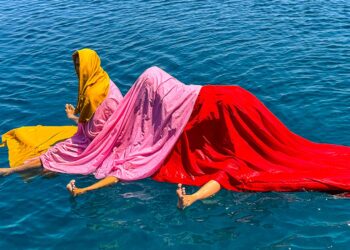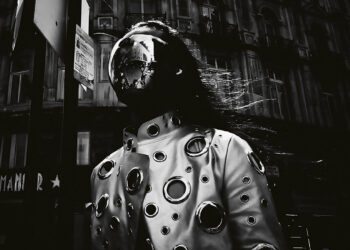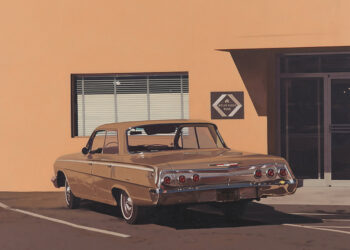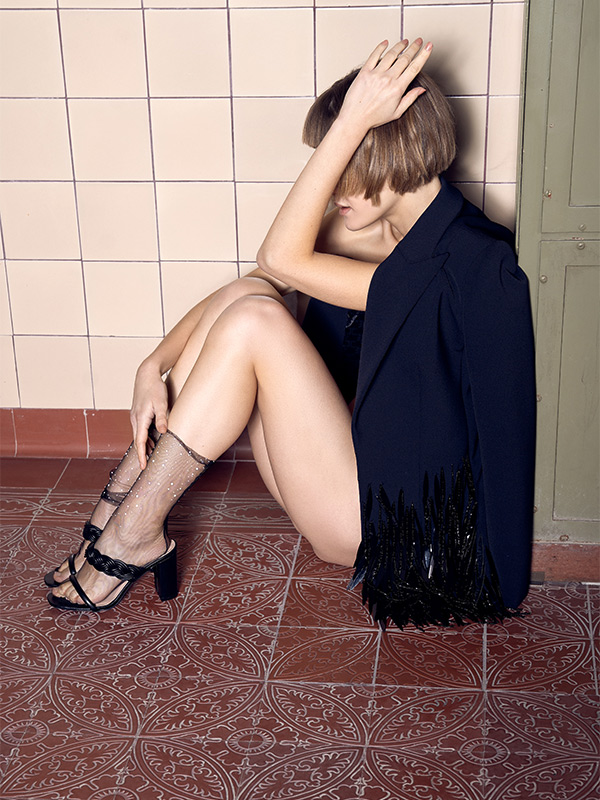


On his forays through the city Nicolaus Armani not just steps, but above all photos. In this interview, he reveals why he draws inspiration from other artists without any jealousy, what his perfect day looks like and how he manages to breathe timelessness into his photos.
F: Apart from your art, you don’t reveal much about yourself online. So our first question: Who are you and how would you describe yourself to someone who doesn’t know you?
Nicolaus Armani: I’m a self-taught photographer from New Jersey who loves to shoot the city and enjoy life. I try not to take things too seriously and am always looking for ways to have fun. Traveling, reading and taking walks in the city and nature help me find a sense of calm – even if life doesn’t always cooperate. I honestly don’t know how else I would describe myself – I just try to be nice to everyone I meet and enjoy the little things.
F: You find the most timeless people and places for your photos – sometimes it’s difficult to tell whether a picture is from 2025 or 1950. Are you a time traveler or is there another secret behind your pictures?
NA: If only there was time travel… My work is created by endlessly wandering around the city. Every now and then I get lucky and capture a timeless moment hidden in the modern world. The best images just happen – I simply exist and notice the beautiful things as they appear.
Q: Would you actually prefer to walk the streets in the fifties or is it just the aesthetics of that time that appeals to you?
NA: It would definitely make photography easier, that’s for sure. Whether I would really want to live in that era, I don’t know. It’s mainly the design, the aesthetics and the general feel that appeals to me.
F: Speaking of the 1950s and looking at your work, traces of Saul Leiter, Vivian Maier and co. are clearly visible in your pictures. Are these early icons of street photography your greatest inspirations? Are there also less obvious inspirations that influence your work?
NA: Saul Leiter is my biggest inspiration – not only in photography, but also in life. His work and his point of view have influenced me a lot. Some others who inspire me are Sergio Larrain, Ernst Haas and Boris Savelev, although there are probably too many to name. I also really appreciate painters like Édouard Vuillard and Pierre Bonnard.
Q: What sparked your interest in photography?
NA: I got into photography via Instagram in 2017. From there, it evolved into what it is today. It all happened pretty quickly – I was immediately hooked when I discovered the work of some incredible photographers from New York City. Living only an hour and a half away, I jumped on the train the very next day with a cheap DSLR and started experimenting and trying to emulate the greats like Leiter, Haas and Gruyaert.
“Saul Leiter is my greatest inspiration – not only in photography, but also in life.”
Q: Do you remember the first picture you ever took?
NA: I probably took the very first picture with a cell phone. It didn’t really click for me until I started traveling to New York regularly. From then on, I really started to take it seriously.
F: How do you define street photography in your own words? What is it that makes it worthwhile for you?
NA: I don’t really call it street photography these days, but if I had to define it, I’d say it’s the pursuit of presence, the act of being fully in the moment, and the search for the beauty that’s hidden in the city. It gets me out of the house and into the world – that’s what makes it worthwhile.
Q: Can street photography be learned or practiced at all, or is it more intuitive?
NA: It’s a mixture of both. You have to be willing to put in some time and work – that’s where the practice comes in. With time and a lot of practice, you refine the intuitive side and it becomes easier – at least that’s what I tell myself.
F: Occasionally there are discussions about the ethics of street photography and photographing people without their knowledge. Do you follow the discourse?
NA: Not really, that’s why I don’t have a clear opinion. I think it’s fine as long as you don’t disturb people or spoil the scene or the surroundings.
F: Have you had any unpleasant encounters while out and about taking photos? Do people even notice you?
NA: In my early days there were some heated moments, especially when I was experimenting with wider lenses and figuring out what kind of pictures I wanted to take. Now I’m more experienced – I know how to shoot, what to look out for and who to avoid. Most of the time, people don’t even notice me. The ones who do notice me are usually not the ones I’m photographing.
Q: Do you also dabble in other genres of photography?
NA: Not really. I have started working with models, but not in the studio, but also on the street or in an abstract environment. And when I’m out in nature, I leave the camera at home – I’d rather experience the landscape than try to capture it.
Q: What does a perfect photography day look like for you?
NA: It’s a warm, sunny spring afternoon in Paris. I just have my camera and a zoom lens with me and I’m walking through the fifth and sixth arrondissements. No set program – just walking, stopping in cafés, watching people and capturing reflections. That’s all I need.
“AI has no place in fine art and photography.”
Q : Are you as frustrated with Instagram as most artists are right now?
NA: I’m not a fan of the direction Instagram is going, but since it’s out of my control, I’m not too stressed about it.
Q: What do you think of artificial intelligence, which is rapidly finding its way into photography?
NA: I think AI has no place in fine art and photography. I have yet to see any AI-generated images that I really like.
Q: Is there a photography rule that you like to break?
NA: I probably break all the rules all the time as I don’t follow any anyway.
Q: Are people too quick to call themselves a photographer these days just because they bought an expensive camera?
NA: As long as it doesn’t hurt anyone, people should do what makes them happy. If it makes them happy to buy an expensive camera and call themselves a photographer, then go for it. Life is too short to judge others for such things.
Q: Is there a photo that you wish you had taken yourself?
NA: I’m not really jealous of other people’s work – when I see something I like, it just inspires me. All of Leiter’s work in Paris is definitely my favorite.
Q: How much of yourself is reflected in your photos, even if you remain invisible and mysterious?
NA: I spend little time analyzing myself to find a connection to my work. I guess that’s what adds to the mystery. I’m just here, present and enjoying sharing what I find beautiful in the world.
Q: Did your paintings evolve over time, or did you find your distinctive style quickly?
NA: It did take time. The overlays and the complexity of the reflections came first, and the reds and color consistency developed later. It took many shots before it really became my own style.
Q: How does a photo start for you? In your head and then you look for it outside, or spontaneously?
NA: I just look for things in the world. Even when I’m photographing a model, I’ve usually already found the locations or compositions – I either wait for a subject to appear or I place the model in the scene.
F: Do you listen to music while taking pictures? What is the soundtrack to your pictures?
NA: That’s difficult to answer. I listen to different genres depending on the day and my mood. A few styles of music actually suit my work, but I’d rather not reveal them. I like to leave it up to the viewer to interpret the picture and the music themselves.
F: New York and Paris are probably some of the most photogenic places. Where else would you like to roam with your camera?
NA: I’m looking forward to traveling to Italy, Switzerland, Portugal and maybe Morocco and Cuba one day. I’m sure my list will get longer and longer as time goes on. I would also like to explore some Eastern European countries.
F: You probably know New York best. Are there areas of the city that haven’t been properly captured or that deserve to be shown more?
NA: I’m sure there are many locations depending on what style you want to photograph. I think this spring and summer I will focus on exploring Upper Manhattan.
“The only goal is to love the process.”
Q: Who would you like to have in front of your lens one day?
NA: No one specific – any model who wants to.
Q: What photo haven’t you taken yet, but you really want to take one?
NA: It’s not about a specific photo, but rather about new places I want to visit.
Q: How do you spend your time when you don’t have a camera in your hand?
NA: I love sitting in cafés, reading books and going for walks in nature or in the park. Living a really simple life.
Q: Do you have any specific photography goals for the future?
NA: The only goal is to love the process and continue to create work that speaks to my soul.
Q: A few quick questions at the end…
… color or black and white?
NA: It depends on the picture.
… Analog or digital?
NA: More digital because of the high prices, but I love film and the whole process involved.
… Street or studio?
NA: Street, forever.
… Instagram or a physical photo book?
NA: Both are cool in their own way.
…flash or natural light?
NA: Natural light wins.
…New York or Paris?
NA: Always Paris.
You can view more of Nicolaus’ timeless works here.
Follow Nicolaus Armani on Instagram.
Photos: © Nicolaus Armani