
His pseudonym, “nameless,” came about when, as a 16-year-old, he was frantically typing away on the keyboard while filling out the registration form for a local film competition. Today, however, the photographer is also known by his real name, Bram van Dijk. The Parisian by choice isn’t just creative when it comes to choosing a name: He films, specializes in editorial and product photography, and doesn’t just hunt for idyllic scenes on the street—he also throws himself right into the middle of a protest. In this interview, the Dutch photographer explains why he deleted all of his very first photos as a child and why he carries a different camera to a party than he does on the street.
FACES: You capture a wide variety of scenes—from relaxed moments on the beaches of southern France to demonstrations in the city and editorial shoots. What kind of people or scenes do you most enjoy photographing?
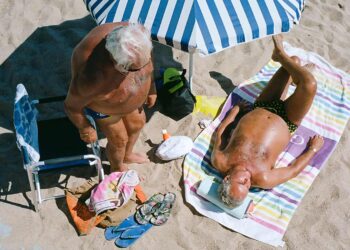
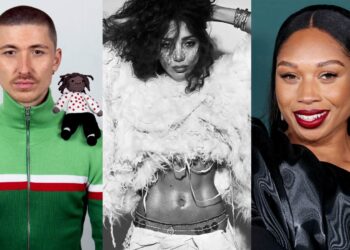
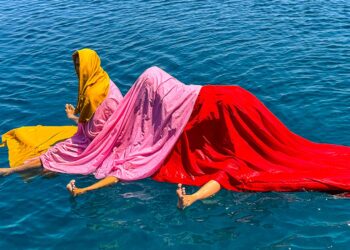
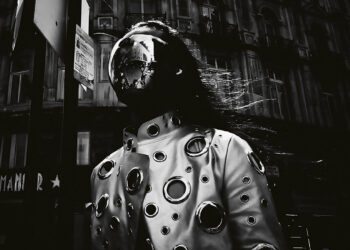
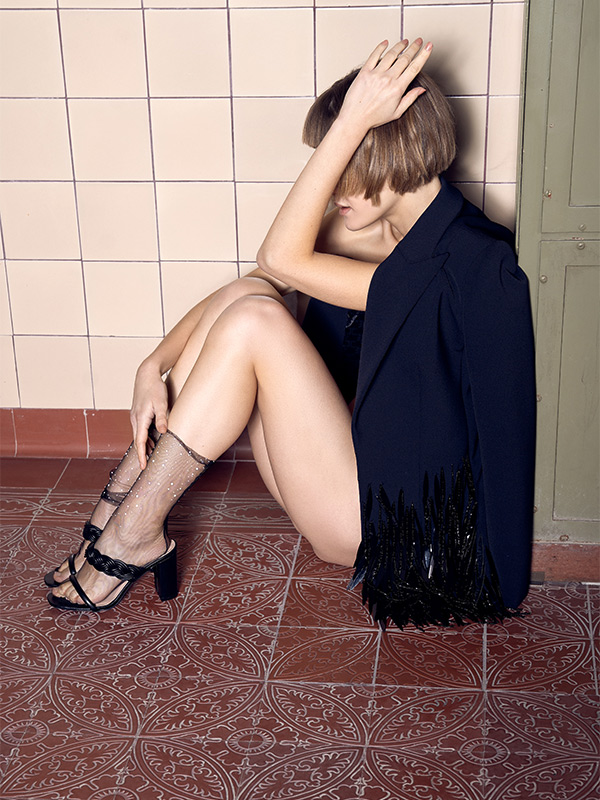
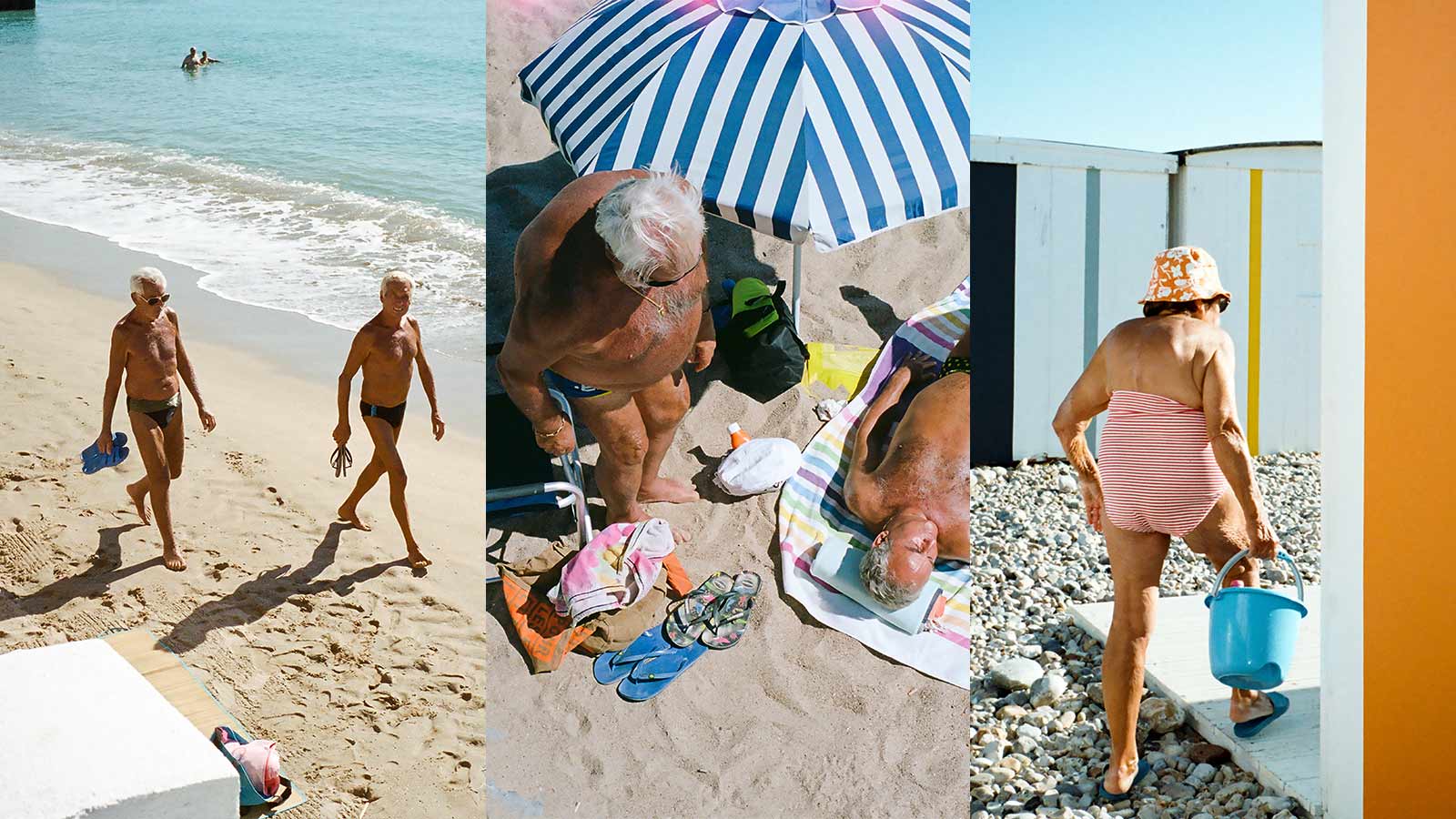
Bram van Dijk: Each of these scenarios has its own appeal. It’s nice to be able to switch between them. Photographing protests in Paris is exciting—the tension between the crowd and the police, combined with the billowing tear gas, creates an adrenaline-fueled situation where you have to act fast. It’s a delicate balancing act full of fleeting, photogenic moments. My other street photography work, such as the photos from southern France, focuses a bit more on people in their everyday lives. A documentation of life rather than an event. It’s hard to explain what moves me to take a photo of something or someone—usually it’s something extraordinary that catches my eye, a unique character or an emotion, sometimes with a humorous twist. Often something that feels somehow timeless. In my work as a director or editorial photographer, the situation is quite different. There are moments when I dream of a specific photo I’d love to take, but one that’s impossible to find in a real-life street photography scenario. In those cases, a staged setting is the perfect way to bring those ideas to life.
Q: When did you discover photography as an art form?
BvD: My first formative encounter with photography came through old skate magazines like Kingpin, Transworld, and even Vice. An older friend of my sister’s gave me a few issues when I was about twelve. I found it fascinating to immerse myself in all these different places, ways of life, and subcultures. Skate magazines offer a great mix of trick shots and lifestyle photography. I’m firmly convinced that’s where my love for the documentary side of photography began.
Q: Do you remember the first photo you ever took?
BvD: One of my most vivid childhood memories related to photography is sitting in the back seat of my parents’ car—I must have been about eleven years old—as we were on our way back from a summer vacation in France. To pass the time, I was playing around with a beat-up old digital camera that I’d bought with my allowance. My parents weren’t particularly interested in photography, so this was probably one of our first family outings to be documented with a digital camera. As I was browsing through some of the photos I’d taken, I wanted to see if I could change the aspect ratio of a photo. In the English menu, I searched for the word that would come closest to the Dutch translation of “size” or “aspect ratio” and came across “format,” which is —but unfortunately doesn’t mean the same thing in a photography context. So I actually accidentally deleted all my first photos, just to pass the time (laughs).
“New equipment can motivate me to experiment and create new works.”
Q: How has your photography evolved over the years?
BvD: While studying film, I began experimenting with photography to improve my skills in framing, focusing, and understanding light. I hoped this would help me become a better cinematographer. Most of these early images were in landscape orientation and modeled after the aspect ratio of traditional cinema. After a while, I began taking more vertical photos and experimented a lot with flash. From then on, it was no longer just a means to improve my skills as a cinematographer, but evolved into a distinct way of seeing and working. Over the years, I’ve experimented with various techniques, cameras, and subjects. They’ve all played a role in the development of my style. New equipment can motivate me to experiment and create new work.
Q: Your pen name is nahmlos. How did you come up with it, and why did you choose it?
BvD: It’s a variation on the Dutch word “naamloos” (nameless). When I was 16, I submitted a short video project—which I had filmed with some friends—to a local film festival for children. On the registration form, I was asked to provide the name of the “production.” Since I didn’t know what “production” meant, I typed in different variations of the word “anonymous”: “anoooooonymous,” “anohnumouhs,” then “naamloos,” “naaaahmloooos,” and finally “nahmlos.” For years, I’ve liked the idea that artists and musicians put their work before themselves. When the time came to share my creations online, I thought it would be funny to stick with the pseudonym “nahmlos.” It wasn’t until recent years that I started using my real name in my online presence. Some people had trouble finding my work, and after being addressed as “nahmlos” in real life, I decided to be a bit more flexible when it came to hiding behind the pseudonym. I’m Bram, and some of my works are by nahmlos. The line between the two is as clear as it is vague in my mind.
F: Which is your camera of choice?
BvD: That’s a tough question to answer. Every situation and every shot requires its own equipment or approach to achieve the desired result. When I go skating or am at a party, I usually just take a small analog compact camera with me, like the Olympus Mju II or the Contax T2. When I’m shooting editorial work, product photos, or fashion shots, I prefer to use my trusty old Nikon FM or the Contax G2 I recently bought. When I’m shooting on the street, though, I reach for the Leica M6. I’ve had this camera for over ten years now, and I feel like I can trust it more than any other. If the picture is blurry or the exposure is off, it’s my fault, not the camera’s. I’d rather get frustrated with myself than with the slow autofocus that some of these cameras can have in low-light conditions (laughs).
Q: That’s a pretty specific list of cameras. Do you think the equipment matters, or can you ultimately take a good photo with any camera—even a cell phone?
BvD: You can certainly create fantastic images with any kind of photography equipment. However, if you’re aiming for a specific result or a specific way of working, then the equipment can still play a major role.
“I like to think about the combination of coincidences that all have to come together at the right time to create good street photos.”
Q: The question of ethics comes up time and again in street photography. What are your thoughts on this?
BvD: This is a difficult topic, especially because the term “street photography” is very broad and every style brings its own set of questions and judgments. The use of direct flash in street photography is often heavily criticized, while others question covert shots taken with a cell phone or with a zoom lens from a great distance. Since I myself don’t particularly like having my picture taken, I sometimes feel these inner conflicts. I’m not entirely sure if what I’m doing is right, but I still believe the result is ultimately worth it. I’m not out to ruin anyone’s day, and I have no ill intentions. So on the rare occasions when someone takes issue with my photography, I can easily explain myself and understand their objection. Most of the time, these conversations end with a handshake or a “Have a nice day, too.” It’s important that things be done with a certain degree of integrity and good taste. However, since taste is subjective and it’s difficult to discern the true intention or integrity behind an image, the question of ethics will continue to be an ever-evolving discussion.
Q: What role does street photography play in documenting history and preserving moments?
BvD: Looking back at the past, early photography began much like Renaissance painting: people were portrayed the way they wanted to be remembered. Stylish clothing, elaborate hairstyles—it was a staged and curated version of history. But as cameras became smaller and more affordable, photojournalists, street photographers, and later even ordinary households were able to document not only historical events but also their everyday lives. When you leaf through the archives of Magnum Photos, “The Anonymous Project,” or countless other books on street photography, you can clearly see how photography has preserved the past. Even if these images aren’t always historically accurate, they still offer a somewhat more authentic glimpse into life back then.
Q: What can a street photo convey that words or other art forms cannot?
BvD: I like to think about the combination of coincidences that all have to come together at the right time for good street photos to emerge. Just like in real life, the beauty lies in those rare moments when everything fits together perfectly. You can’t plan for moments like that, but you have to be ready when one happens. It can be over in a fraction of a second.
Q: Which other female photographers or artists inspire you the most?
BvD: There are countless ones: Jill Freedman, Richard Sandler, Lars Tunbjörk, Andy Breen, Bertien van Manen, Bruce Gilden, Vivian Maier, Jon Walker, Helmut Newton, Martin Parr, Ed Templeton—they’ve all inspired me in different ways at various times in my life.
Q: How do you like to spend your time when you’re not taking photos or filming?
BvD: Besides my work as a freelance video editor, I like to be out and about. Going skating, hanging out with friends, visiting an exhibition, or going to a concert. Since I live in Paris, it’s very easy to always be doing something—there’s always something to see or do. But since I have a camera with me 99 percent of the time I leave the house, there’s still a good chance I’ll snap a photo every now and then (laughs).
“An image created entirely by computer that looks like a photograph is not a photograph.”
Q: Artificial intelligence is becoming an increasingly prominent topic in art and photography. What are your thoughts on this? Do you think AI could ever pose a threat to photography?
BvD: AI is already a massive threat to photography. Not only because it will become impossible to distinguish between real and fake images in photojournalism, but also from a financial standpoint. There are numerous art and street photographers who cannot make a living from their art. As a result, they rely on commercial side projects to continue their artistic work. Since some of these commercial projects are being replaced by AI, it is becoming increasingly difficult to self-fund projects. Society’s perception of images and their value has changed significantly in recent decades, and AI is merely the next chapter in this evolution.
Q: What do you think of people who use AI to create photographs or other works of art?
BvD: It must be labeled accordingly. An image created entirely artificially that looks like a photograph is not a photograph. The line becomes blurred when images are half-photographed and half-composed in post-production. Personally, I prefer to work with elements that are as real as possible. This goes without saying for street photography, but even in my work as a director and editorial photographer, I prefer to be on location with real models and real people who help set up an authentic scene. However, when things are impossible in the real world or the budget doesn’t allow for a vision to be realized, I have no objection to using AI as a tool in post-production to help the image editor or 3D artist achieve the desired result more quickly. Perhaps we should simply find a different term to define these projects—something like “visual collage art” or “image design”—instead of hiding them under the umbrella term of photography. For me, the real problem begins when AI encroaches on street photography and photojournalism. These are fields where the unwritten rule of authenticity is of the utmost importance—and AI has no place there.
Q: What are your thoughts on social media? Are Instagram and other platforms a good way to grow as an artist, or do you find it difficult to stand out from the crowd and build an audience?
BvD: Like many others, I have a love-hate relationship with social media, especially Instagram. It’s a great place to connect with people and discover their work, but it’s also a place where it’s easy to lose yourself. Certain kinds of art just aren’t meant for small screens, algorithms, likes, and vertical formats. One of the reasons I like to shoot on film or other physical media is the tactile aspect. You have something you can hold in your hands that exists in the real world. Likes, followers, and views can feel so abstract. Even though it influences me in some ways, I try not to get too caught up in it.
Q: What’s on your bucket list?
BvD: Someday—when I’m old—I’d like to put together a retrospective photo book. Basically, a life’s work in pictures that I can hold in my hands.
BRAM VAN DIJK
His pseudonym may be nameless, but the Dutchman goes by the name Bram van Dijk. As much as he dislikes being in front of the camera, he loves pressing the shutter button. Bram is passionate about both moving images and photography. He edits videos, films, documents protests, and captures people on the beach and in the city—and he also knows how to showcase fashion and products effectively.
nahmlos.com
Off to the beach: Check out how Bram van Dijk turns doing nothing into art.
Let Bram van Dijk’s creativity inspire you.