
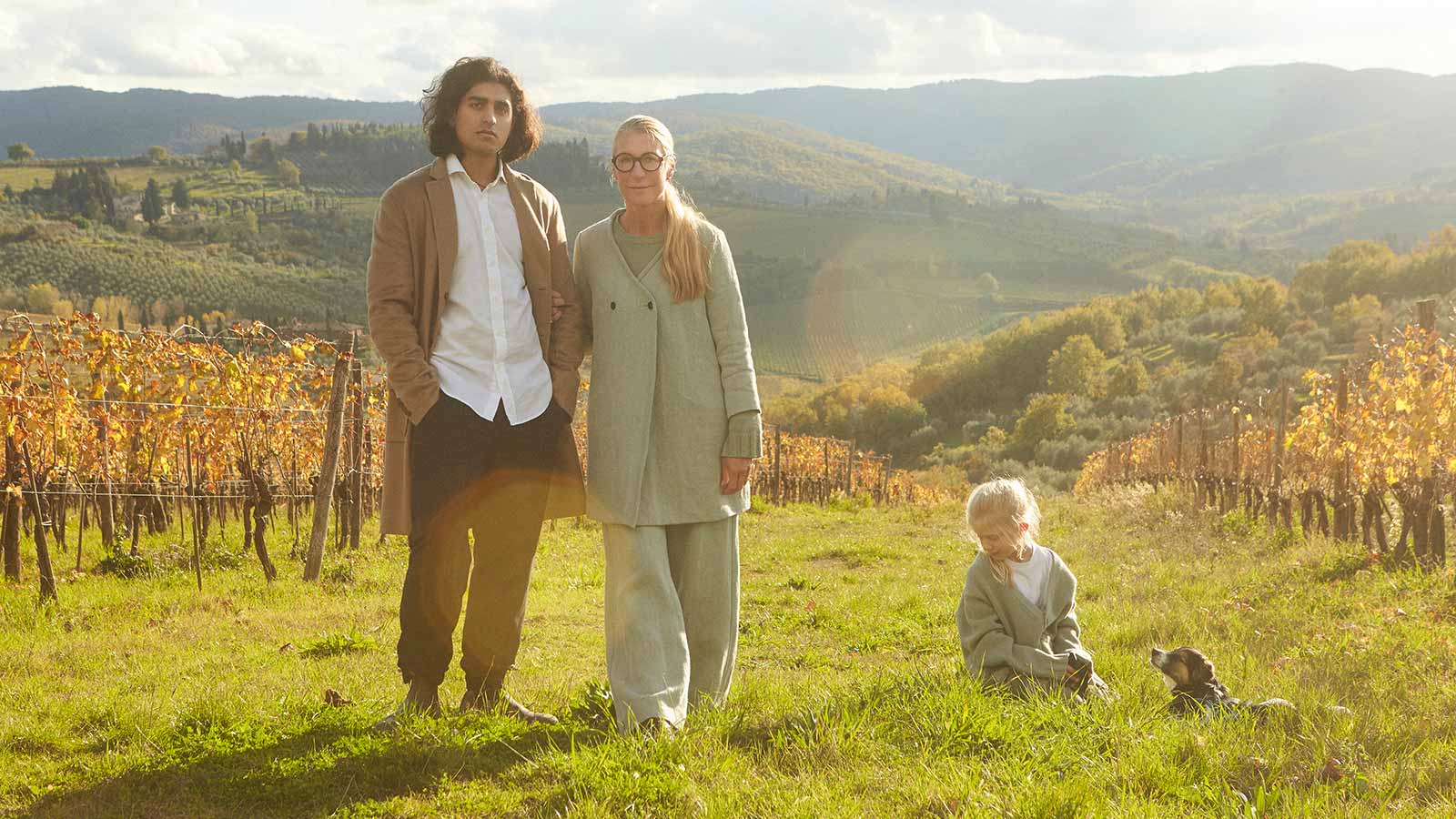
The fashion of Neri Firenze embodies restraint—and a great deal of conviction. When founder Raphaela Hermes puts her designs into production, it’s not dreary large-scale factories that set their assembly lines in motion. Instead, local artisans from Florence reach for tools that have often been passed down through generations in their families—along with the secrets of the highest care and quality. In this interview, Raphaela reveals how closely the brand is tied to her personal family history, how traditions and experimentation can be combined, and what she considers true luxury.
FACES: You’re originally from Solingen but have been living and working in the Florence area for many years. Are there qualities in your work that are unmistakably German—and which ones could you never have developed without Italy?
Raphaela Hermes: An unmistakably German quality is certainly punctuality and reliability. I’ve also always been careful to grow slowly, take small steps, and not overextend myself. In Italy, on the other hand, you learn improvisation. As the saying goes: All roads lead to Rome. Due to the sometimes charmingly chaotic way of working and the Italian temperament, you have to proceed diplomatically. Even when it comes to criticism—ideally with plenty of humor. You also have to make decisions quickly to reach your goal. These can look completely different in the moment from what you originally planned.
F: You grew up in a family of artisans. Tell us more about that. What lessons were you given early on that still guide you in your work today?
RH: On my father’s side, I come from a long-established family of artisans. My great-grandfather was already a master builder, and our connection to craftsmanship goes back many generations. He was a certified conservator and lecturer at the Academy of Crafts. That awakened in me a passion for things made by hand and for materials, especially natural ones. On the other hand, I come from a long-established Westphalian family. From there, I certainly inherited my sense of restraint, understatement, and subtle nuances that still shape my aesthetic today. I still remember how my father would buy loads of quark and use it in combination with clay and straw to restore the infill panels of old timber-frame houses. Behind every craft lies a science. For example, building a water wheel for a water mill and knowing exactly at what angle the wooden paddles must be positioned in relation to the speed of the river and how deep the wheel must sink into the river for the millstone to turn at the desired speed. My father was one of the last conservators who mastered this technique and learned it from a specialist over 90 years old. I also inherited from my father how important it is to keep developing and learning and trying new things. Right up to the end, he bought new specialist books and continued his education. What’s good today can be better tomorrow. That’s why I’m always interested in constantly developing the know-how and quality.
F: What fashion and people inspired you early on and sparked your enthusiasm for the industry?
RH: There isn’t really one specific person. Honestly, I was a keen observer even as a child and fascinated by materials and aesthetics, and I developed my own taste early on. Fashion was fun for me from a young age, and I remember discussing with my mother when I didn’t like an outfit or my braids were a bit crooked and I didn’t want to go to school like that. But I do want to emphasize that I always liked Jil Sander’s early fashion, and on my travels as a young woman I was able to meet Signor Solbiati from Como, also known as the linen baron. I ran into him several more times at the Pitti Uomo trade fair in Florence. I was always fascinated that he wore linen suits all year round and white Superga sneakers. For me too, linen is a fantastic and casually elegant material that you can wear all year, from thicker to thinner weights. I can say: a fascinating man with personality, great humanity, and somehow still a big kid. I had the honor of being a guest once in his lovingly furnished villa in Como. And I can still remember the small display cases with old toys and curious objects. He seemed like a kindred spirit to me. Because I also very much like to bring a bit of humor or a little twist into my fashion here and there. I’m also a passionate collector myself—among other things, I have a collection of small children’s sewing machines from the seventies.
“What’s good today can be better tomorrow. That’s why I’m always interested in constantly developing the know-how and quality.”
F: Before Neri Firenze, you worked for various larger fashion brands. What motivated you to found your own label?
RH: The founding was a combination of several factors. The first was that I became pregnant and my partner at the time took about one second after the news to leave me. I had to rethink quickly, because an abortion was out of the question for me. But I also couldn’t continue flying to design meetings with what lay ahead of me as an expectant mother. Another factor was the constantly shrinking budgets of the fashion companies commissioning work. Money was increasingly going into marketing and events instead of quality. So I thought, if I can design for others, I can do it for myself, and I’ll swim completely against the current. Many thought I was crazy. I started using only the best materials, quality over quantity. Going against the trend of producing cheaply in Asia. That wasn’t easy, because I was employed by my previous employer and only received a small severance of around 5,000 euros. With that, I financed my first accessories collection and did research. The first person who caught my attention was Andreas Murkudis in Berlin. I wrote him a letter and sent one of my most beautiful scarves. In cashmere-silk, only 69 grams, made on a hand loom. Then I waited and was actually invited. I still remember traveling to Berlin with my small suitcase filled with samples. There I had a very nice conversation with Andreas. We immediately shared the same wavelength of values and quality. He had an immediate eye for what’s special. He was one of my first customers, and we still work together with pleasure today. That motivated me and confirmed that I was on the right track with my idea.
F: Running an independent brand means being simultaneously a designer, entrepreneur, and often a personal ambassador. Which of these roles is hardest for you, and in which do you recognize yourself most clearly?
RH: I see myself more as a designer and ambassador for my brand. Bureaucracy has never been my great strength. I’m rather weak in the business area. Add to that modesty and down-to-earthness. Some customers have told me: For what you offer, your prices should actually be much higher. I’m not a self-promoter and not a social media specialist. Sometimes it wears me down when I see mediocre collections with questionable material compositions that aren’t even cleanly sewn selling like gold. And putting on a big show, followed by sponsors who provide a lot of money for it.
F: You named Neri Firenze after your son Neri Cristiano. Does the brand therefore carry an even deeper emotional meaning for you, and can this sometimes be forgotten in a day-to-day dominated by business figures?
RH: I named my brand after my son because he was the catalyst for everything. Everything is emotional to this day. Back then, I invented the Infinity Bow—the endless loop—which remains a silent brand ambassador to this day. It appears on leather goods. I’ve often incorporated this element into clothing as well. The background is the infinite love for my son, who gave me the strength and courage to start this adventure. We had to survive. I had to finance my life alone, without any help, to feed my child and keep us both afloat. That means everyone who buys a piece also carries a mother’s love and the strength you can develop from it out into the world. Anything is possible if you want it. Nothing has changed about that to this day.
F: Your collections are created within a small network of Florentine artisans. Some over 80 years old, they master techniques that are barely being passed on anymore. Do you also see it as Neri Firenze’s mission to carry these dying craft traditions into a new generation?
RH: I love my network of small workshops that I’ve built up over 20 years, like a truffle hunter. By now I consider them all family. I’ve been working with many since day one, despite difficulties, fates, illnesses, and everything that’s part of life. I’m not a fan of jumping around and looking for the cheaper option, or thinking: The neighbor’s grass is always greener. It’s like a kind of marriage. Once you’ve found good artisans, you’re loyal through good times and bad. I work with the best, whether it’s clothing or leather. You simply see the difference, as if the piece has a special glow, a soul, a particular aura.
F: Consistency and time-tested methods are important factors in your brand DNA. But where do you also like to leave room for experimentation?
RH: I love experiments and always keep my eyes open for interesting new things. In the past, for example, I made windbreaker jackets with a
neoprene-coated yarn that made the whole thing water-repellent. Unfortunately, that experiment didn’t go so well because the yarn kept getting caught on the knitting machines. But there are also great examples of experiments, like my cashmere padding, which I had made last season—quilted lining with recycled cashmere that makes a coat absolutely cozy and thermoregulating. This season I bought a wonderful fabric. Exceptionally not from Italy, but from Switzerland. It’s a gorgeous, super-combed cotton fabric from Christian Fischbacher that also brings a generous dose of humor with it. I also bought fabric from him for shoes and bags—incredibly solid and sturdy, beautiful colors, and extremely durable on top of that. The material is actually an upholstery fabric for armchairs or sofas, but it’s perfect for my idea.
F: A hallmark of Neri Firenze is the use of double cashmere. What makes this material particularly special to you?
RH: At Neri Firenze, we’ve been making so-called double cashmere for many years. I discovered a double cashmere jacket at a fabric supplier and then went searching like a detective to find out who made this gorgeous piece. That led me to an old tailor who makes them by hand, piece by piece, in his small studio. I was absolutely thrilled. But there are extreme quality differences. Many advertise with double face or double cashmere. But true double is handcrafted. It’s a double-woven cashmere made on special looms. I have the material woven and dyed here in Florence. The fabric is essentially cut open like a slice of bread, and the sides are folded inward and hand-stitched. With large companies, that’s simply not possible—given the volumes they sell. It’s all done by machine in large-scale production. True double is pure handwork. The technique originally comes from Sicily. My tailor is also Sicilian—but has been living and working in Florence for many years and learned his craft as a small boy. The beautiful thing about these pieces is that they completely adapt to the wearer because they nestle around you like an invisible shell. You can also see the hand stitching. That perfect, imperfect tailoring artistry. Irregular stitches, because it’s sewn with needle and thread. That makes it charming and unique. I also like to do dropped shoulders because they don’t make the piece look boxy and the fabric falls softly at the shoulder.
“Once you’ve found good artisans, you’re loyal through good times and bad.”
F: For belts and bags, Neri Firenze uses so-called cuoio vegetale. Please explain the difference from ordinary leather.
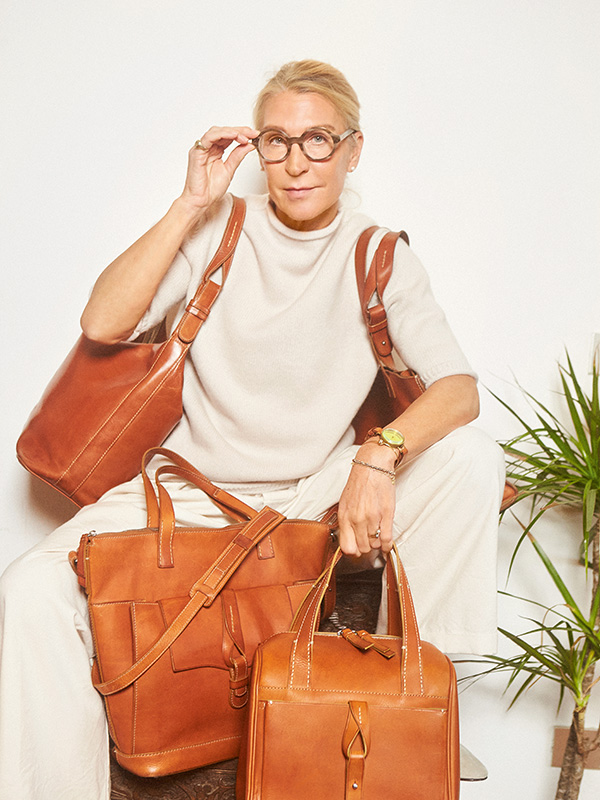
RH: Cuoio vegetale is leather tanned with pure plant oil. Natural pigments are used for coloring. Hides are tanned in barrels according to old Tuscan tradition. This makes the leather free of chemical additives. It retains its natural properties and protects itself through its own fat content. The leather ages beautifully and develops its own patina. Very personal, depending on the owner of the piece. The older the piece becomes, the more beautiful it gets. It protects itself from rain and reacts to cold, heat, or sun just like our skin. The leather stays alive. It’s not completely homogeneous, and you can see irregularities, like a previous injury. I love this non-uniformly dyed quality of the leather. That’s why I’ve been using it from the beginning. That’s also why you shouldn’t leave the bag in direct sunlight for long, under a halogen spotlight, or next to a heat source. If a scratch occurs, you can simply rub it away with your thumb. Plus, the leather lasts forever and a bag becomes a long-term companion for the future. Other leathers are chrome-tanned, for example. They have a perfect surface, but the disadvantage is that they don’t age beautifully—they simply wear out and are chemically treated. Split leather is also often used, bonded with synthetic lower surfaces so it even has any stability. That’s out of the question for me.
F: Neri Firenze stands for quiet, enduring fashion in an industry that thrives on visibility, pace, and constantly new images. How does a brand stay true to itself in this environment and still be successfully perceived?
RH: I think it’s wonderful that Neri Firenze stands for quiet and enduring fashion. Even though many in the industry flood customers with rapid images and constantly suggest new trends, I’ve built up a loyal customer base in the background. It’s about passing on solid knowledge; informing retailers about the special features, about the fabric qualities, the buttons made of horn or Tahitian pearl, special processing methods. A lot happens through personal contact and also the retailer’s skill in letting the passion and spark jump across.
F: What kind of people does the spark jump to? Who do you want to reach with your brand?
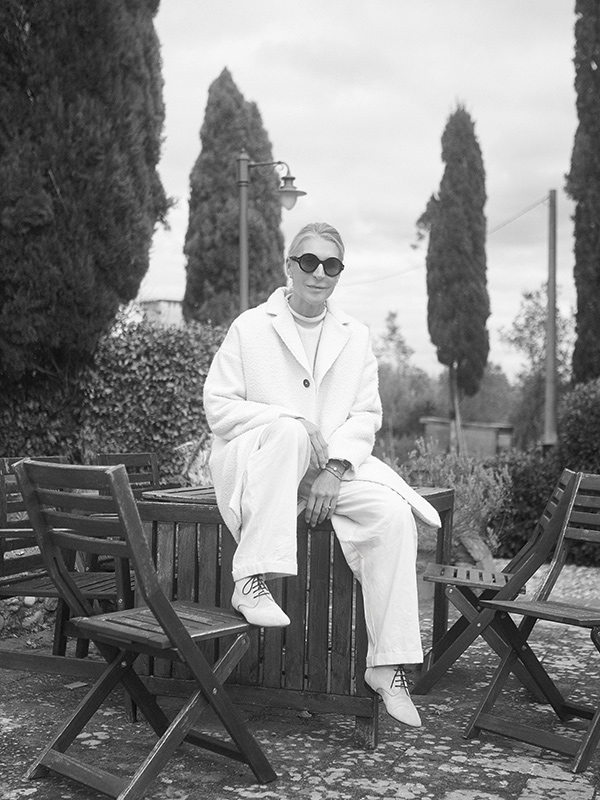
RH: A woman who wears Neri Firenze is a woman with personality who doesn’t value glitter and bling. She doesn’t want to display loud logos or risk sitting in a café with the same handbag as her neighbor. But she very much wants to show that she’s wearing a high-quality product. She’s a woman who arouses interest when she enters a room. A Neri Firenze suit always has a cool cut, and I select special and very high-quality natural fabrics. The trousers are especially popular—they have a relaxed cut, somewhat boyish, laced with humor, and with the right top and accessories the look becomes very feminine. I want wearers to feel comfortable in every situation, not constricted, and always authentic. The clothing should emphasize personality and leave a lasting impression. One point is also my color concept. Customers can always recombine pieces from past collections that they already have in their closet. I call it the Lego system. My color palette is clearly defined. There’s more color in the capsule collection, which can be very playful—but always muted. The main collection, on the other hand, follows a very clear thread. I don’t think you have to reinvent the wheel every season.
F: Neri Firenze’s motto is “The Essence of Rarity.” Is there something in our world that, in your opinion, has become far too rare?
RH: The motto is connected to the uniqueness of production, since I only work with long-established Florentine craft workshops that use special techniques that are family secrets. I track down the special materials like a detective. What’s particularly important to me and unfortunately very rare in the business world is solidarity, understanding, respect for all the wonderful people you work with. I’m always fascinated by artisanal skill. I wish young people would engage with the subject of craftsmanship. There’s that old saying: “A trade in hand finds gold in every land,” and that’s absolutely true. Everything else will eventually be replaced. But human passion and human skill will never be replaced by a machine or computer. Good artisans will be extremely sought after in the future and very well paid. I’m not interested in chasing sales figures. I can’t produce large quantities anyway, because handwork takes time, and the day only has 24 hours. Many collections are limited. Sometimes you also have to accept delays when important employees in the workshop are sick—that’s life. Then there’s a delay, but the result is all the more beautiful afterward—made by a person who worked for you with joy. Large companies immediately wave the lawyer’s letter and contractual penalties for delivery delays and lost profits. But isn’t it also a form of luxury to wear something that has no negative aftertaste and was made with love?
NERI FIRENZE
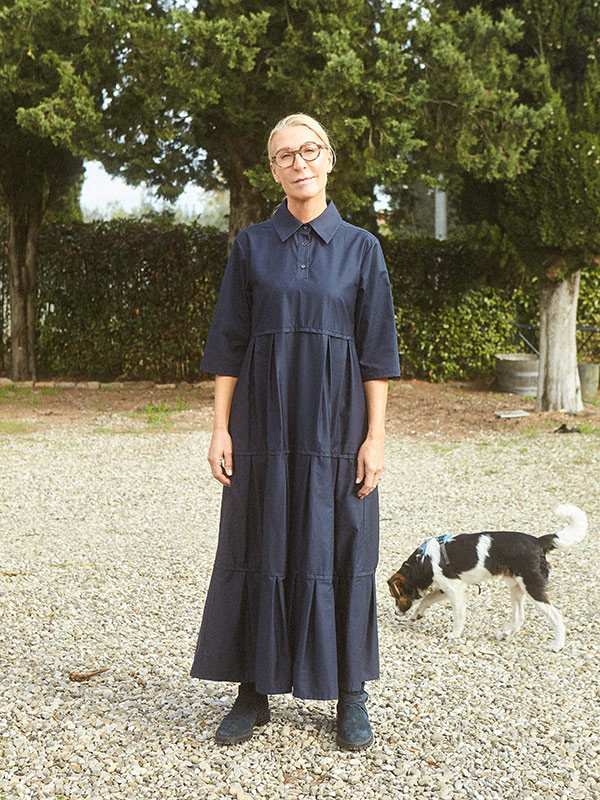
Raphaela Hermes is a designer—but always a bit of a detective too. Namely, when she tracks down exquisite fabrics for her fashion label Neri Firenze. Or small Florentine workshops that preserve centuries-old craftsmanship from extinction. In the process, she creates garments and accessories from double cashmere and vegetable-tanned leather, among other materials. Since 2005, the label has stood for understated design and outstanding quality. A combination that cares for the past and therefore has a great deal of future ahead. nerifirenze.com
Immerse yourself in the minimalist, high-quality world of Neri Firenze here.
Photos: © Mark Pillai
A style icon who also appreciates high-quality materials: Iris von Arnim.