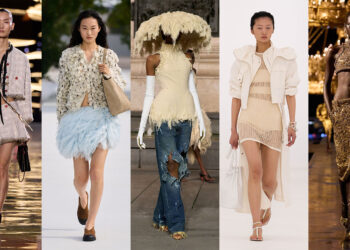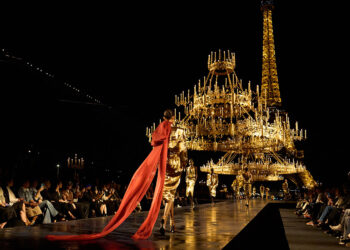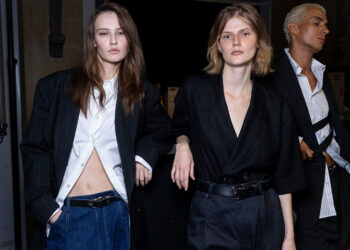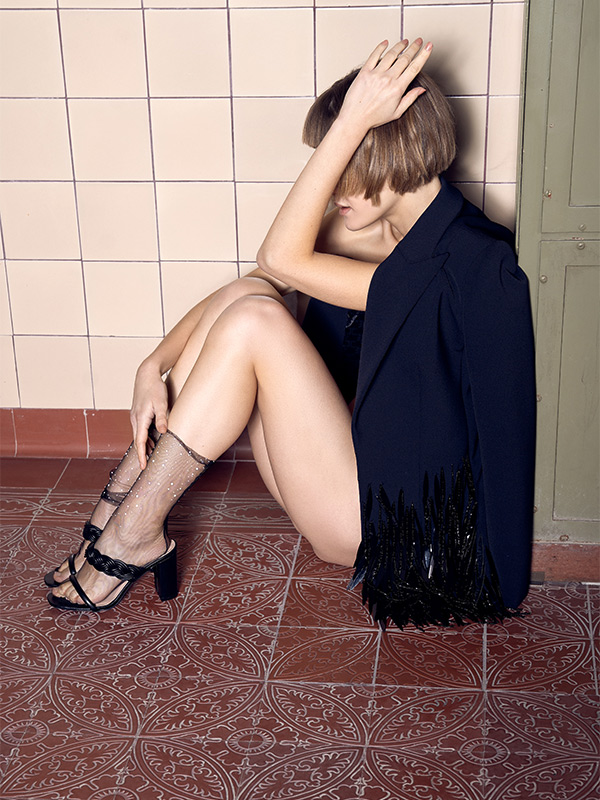

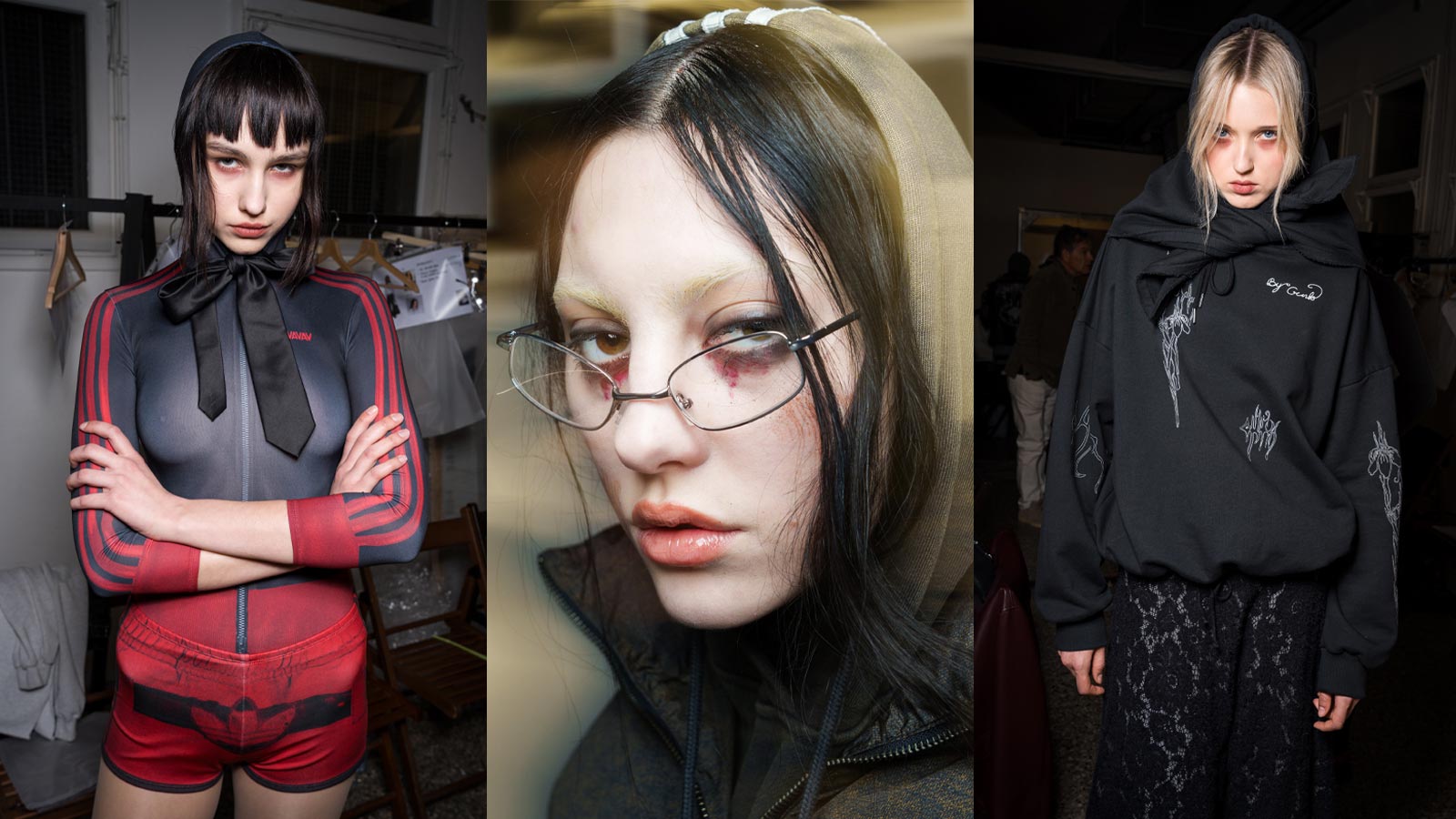
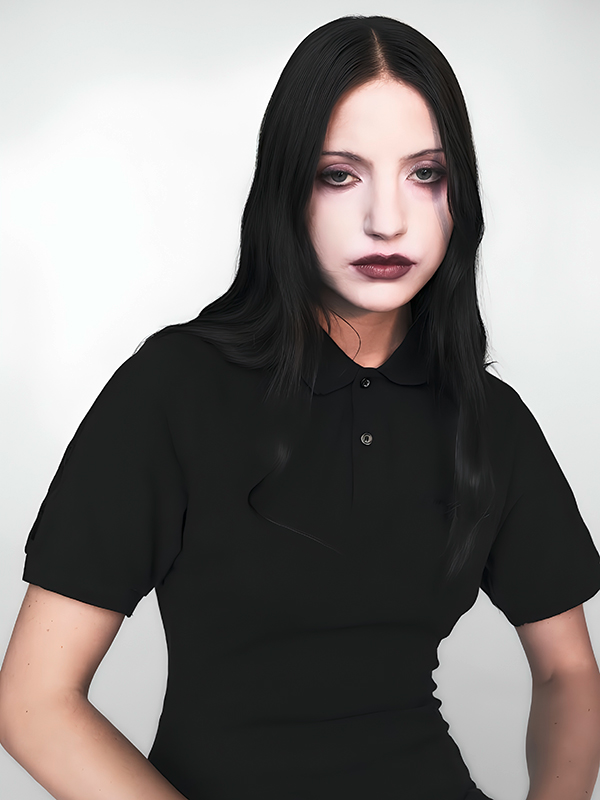
A bit of street style, a bit of high fashion and, above all, a lot of cult: that’s Beate Karlsson’s label Avavav. In five years, the Swede has gathered a loyal fan base around her. At Fashion Week in Milan, she can keep up with the big names when it comes to generating hype: Her latest collection “The Female Gaze”, in which the audience had to walk on the runway and the models stood next to them, was posted up and down on social media. However, the designer is not just interested in attracting attention. Humor, entertainment and design evolution are the three pillars on which she is building her label, striking a chord with the times and almost certainly helping to shape the future of fashion. In this interview, Beate tells us why she wants to break away from familiar structures, why the fashion industry can still be feminist and how concepts for catwalk shows are emerging.
FACES: Imagine you had to introduce yourself to someone who doesn’t know you, using three pieces you designed. Which one would you choose and why?
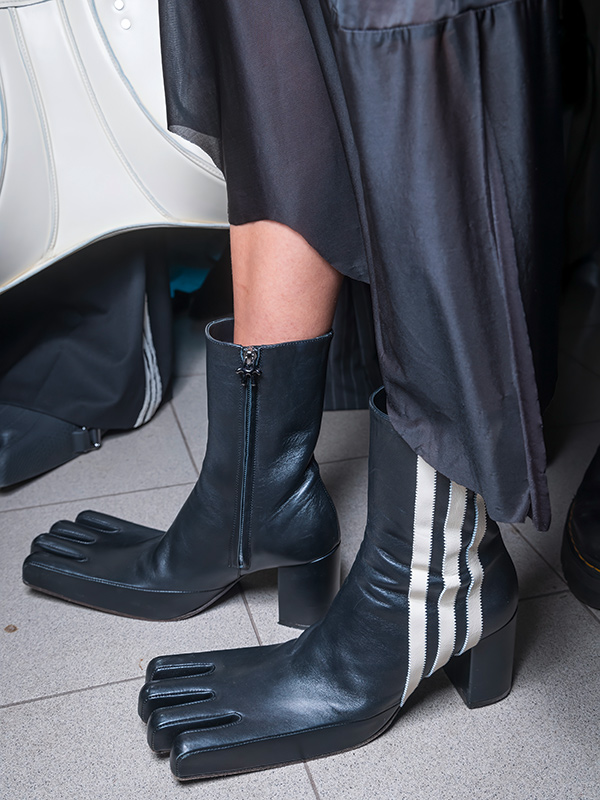
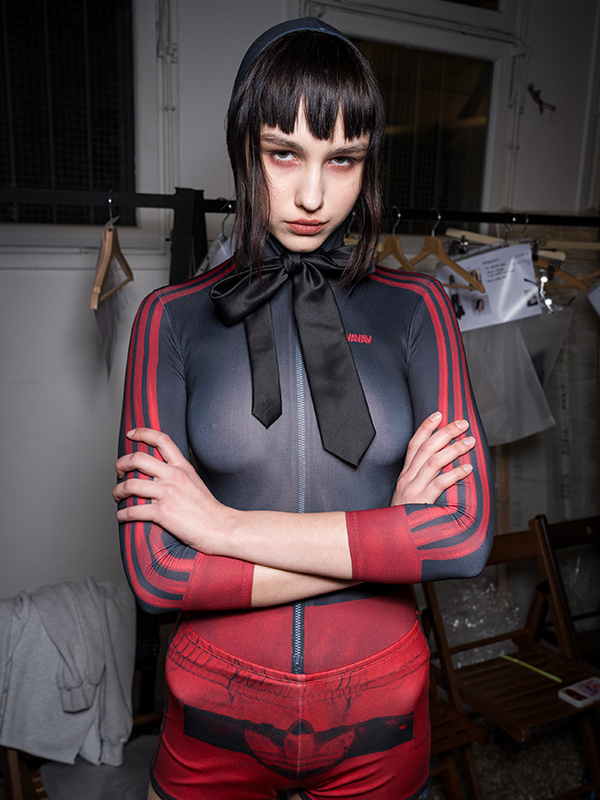
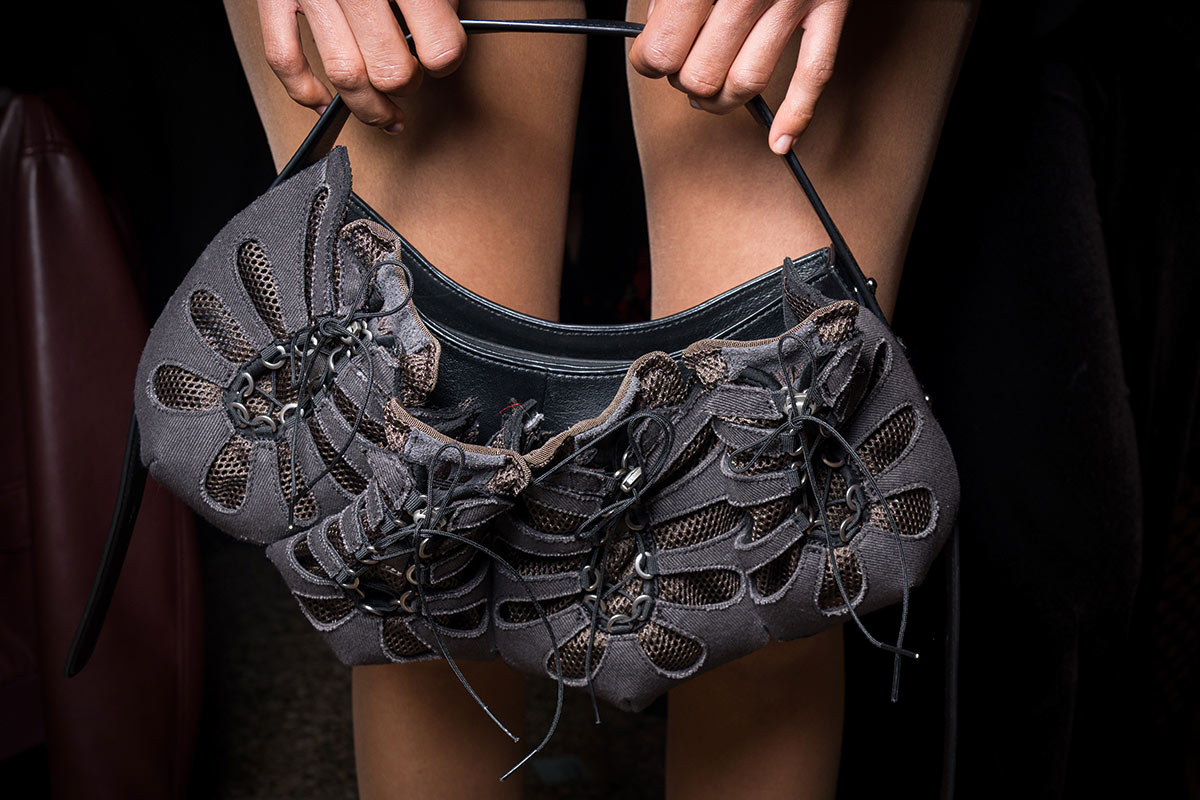
Beate Karlsson: I would probably choose the finger boots, the “Old Lady” jewelry and our Centipede scarf. They all look very lively to me. I’ve always been drawn to designing pieces that behave almost like little creatures. Objects with a kind of presence or personality, rather than just a function. There is something slightly sinister about them, but at the same time they are playful. They are also sculptural, which is a big part of my design philosophy. I’m particularly interested in the interface between sculpture and utility, when something can exist as both an object and a function. All three pieces embody this balance. They almost seem like they can move on their own, and I think that character reflects both me and the world we are building with Avavav.
F: As a young and fast-growing brand whose presentations and catwalk shows often go viral, do you see yourself as a “disruptor” in the fashion industry? To what extent do you want to shake up the industry?
BK: I wouldn’t necessarily describe myself as a “disruptor”, but I am definitely someone who is constantly looking for change. Not just as a designer, but also as a person. For me, that’s the essence of design: you’re either working towards improvement or transformation – or ideally both. Otherwise, I’m not sure what the driving force would be. What interests me more as a label than being a “disruptor” is the idea of not feeling bound by existing structures. There is a certain freedom in allowing yourself to break out of the traditional ways of doing things and instead create something that actually reflects the times we live in. Everything is changing: consumer behavior, the fashion system, the way we share and consume ideas. Everything is evolving at a pace that feels faster than ever before. For me, it feels natural and necessary to embrace this movement rather than resist it. So if there’s any kind of “disruption” in what I’m doing, it comes from trying to find new ways that feel relevant now.
Q: Speaking of virality and disruption: Avavav is still young, but your shows seem to be some of the most talked about. Is this what you envisioned for the brand from the beginning?
BK: Not quite like that, no. But I realized early on that there are some key challenges in this industry – production, distribution and communication. As a young, independent brand, it’s incredibly difficult to build production and distribution from the ground up. These are systems you have to build over time – through relationships, experience and resources. When you’re independent, it’s almost impossible to keep up in these areas right away. What we understood quite early on, however, is that communication is different. Reaching people, telling a story, creating a moment – you can do that even with very limited resources, as long as the idea is strong enough. In a way, it became an area where we could actually stand toe-to-toe with much bigger brands. If you have a clear narrative and a certain creative intensity, you can get just as far, sometimes even further. So the visibility of the shows wasn’t necessarily a goal in itself, but more a natural result of focusing on storytelling as one of the few areas where size doesn’t have to limit you.
F: Instagram and co. are also part of storytelling. What is your relationship with social media? They certainly help you to be visible, but do you also see disadvantages?
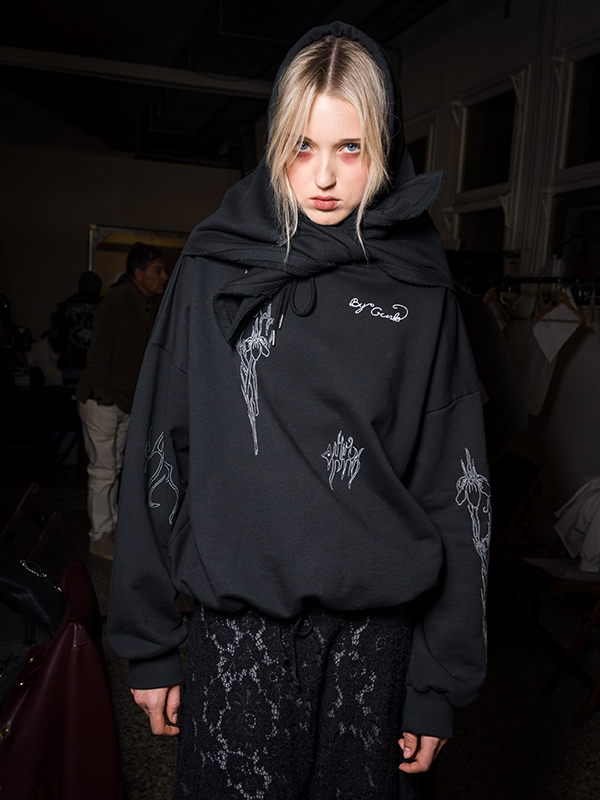
BK: I, like probably many others, have an ambivalent relationship with social media – there is a lot that I really appreciate and a lot that I am rather critical of. On the positive side, it has actually brought some really meaningful connections into my life. I’ve met some of my closest friends through social media – people I would never have met otherwise, from completely different parts of the world. Just through a shared sensibility or similar tastes, you suddenly find each other. This kind of connection didn’t exist before and I’m very grateful for it. I also think it has democratized visibility in a way. As I mentioned before, it allows people to reach an audience without having to rely on the traditional structures. If you have a strong idea, you can be seen and heard regardless of where you start. At the same time, there are obvious disadvantages. There’s toxicity, overpresence and this constant flood of information that makes it harder to focus. Attention spans shrink and everything becomes very immediate and disposable. But what worries me the most is when social media starts to interfere with the physical experience, when you’re no longer fully present because a part of you is constantly performing or watching yourself from a distance. It creates a kind of parallel, digital version of yourself that can pull you away from reality.
“Even if we can’t completely eliminate the male gaze, we can still question it, change it and expand the perspectives around it.”
Q: When did you discover your interest in fashion and was it always your goal to have your own brand?
BK: Even as a child, I was attracted to the idea of creating something of my own, designing and selling my own work. But it wasn’t just about clothes for me, it was more about the act of creating and putting things out into the world. In a more philosophical sense, I always imagined that if traditional structures like jobs or businesses didn’t exist, I would still do something very similar: create objects and present them in some kind of space. Almost like a curious, slightly chaotic souvenir store where everything could exist side by side: Furniture, clothes, sculptures, artifacts. A place where different types of creations exist side by side. Fashion simply became the most immediate medium for me, but my aspirations have always been more expansive. I would like to expand to many different types of objects and products over time. At the same time, I don’t see myself as an artist in the traditional sense. What interests me most is this interface between sculpture and function. That’s where I naturally end up when I create something: objects that are not only expressive but also have a purpose, even if that purpose is somewhat irrational or silly.
Q: How do you come up with a new concept for a fashion show?
BK: It’s different every time. There is no set method, which is part of what makes it interesting, but also a bit unpredictable. Sometimes I start with a clear idea, but mostly it starts with the creative process itself. I start designing, experimenting, and at some point the meaning of the collection reveals itself. It’s almost as if the concept emerges from the work itself and not the other way around. In some cases, I only fully understand what it’s all about once everything is finished. That’s also why I think the pace of the fashion industry can be challenging – it doesn’t always allow enough time for such a process where things unfold more intuitively. But what usually remains the same is that each collection becomes a kind of commentary. It reflects something that I am living through, questioning or find interesting. So even if the starting point changes, the core always comes from my personal environment – something that I try to process, translate or shape.
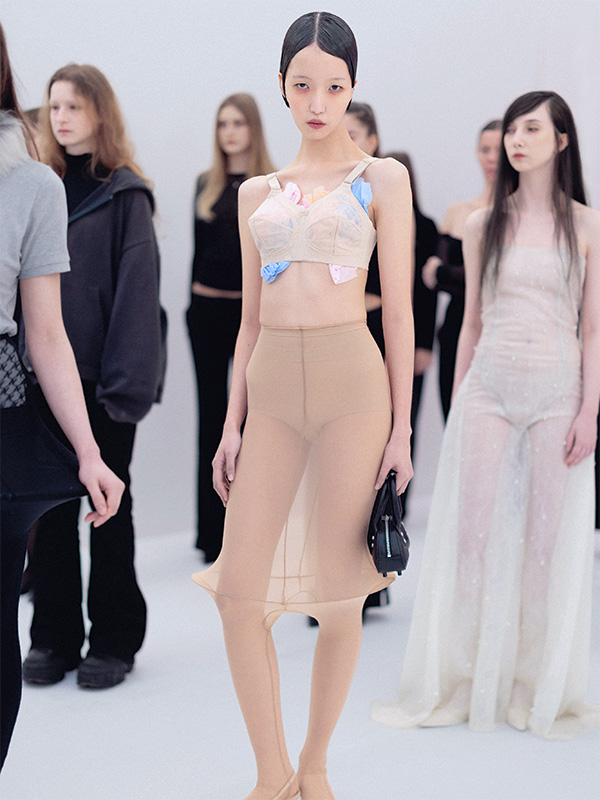
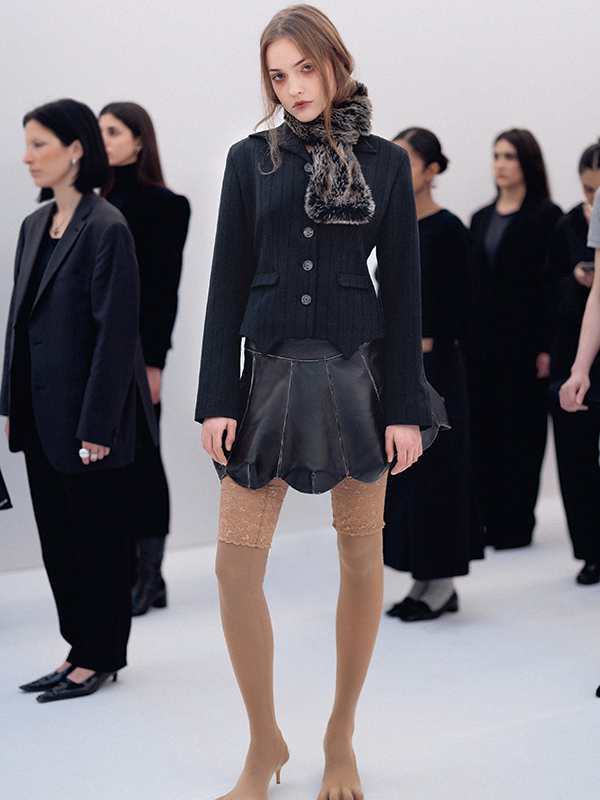
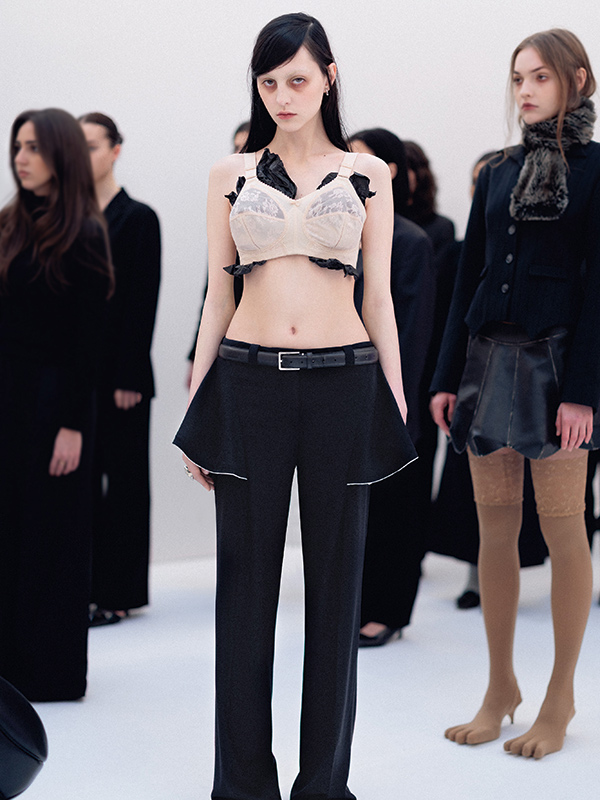
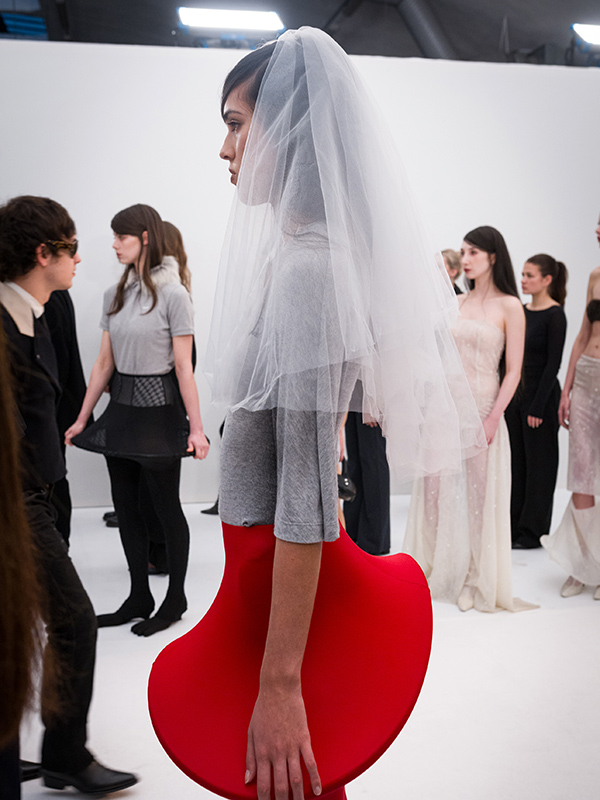
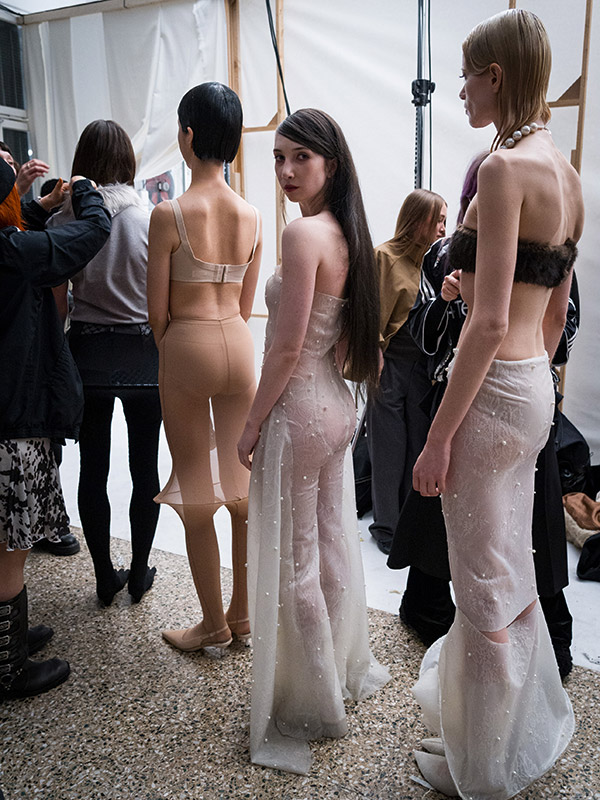
F: The presentation of your fall/winter collection “The Female Gaze” at Milan Fashion Week has once again gone viral. Instead of having the models walk, the audience had to walk up and down the catwalk to see the looks. What do you want people to take away from this show? Were you satisfied with the response?
BK: I try not to dictate to people what they should feel or take away from a show. I have no great interest in directing interpretation or hoping for a certain reaction. What I can say is that the show addressed something that I think is still underrepresented, something that hasn’t been talked about enough. It’s not even meant to be a direct criticism of the industry, but more of an invitation to think about it or spark a conversation. And that is that there is an interesting contradiction in the fashion industry: it is an industry where women have always been at the center – women as consumers, as subjects, as the core of the narrative. And yet, at the same time, there is a clear underrepresentation of female designers and important female voices shaping this narrative. So you have this imbalance where women’s fashion is everywhere, but the female perspective behind it is not equally visible. I find this tension fascinating. With the show, I wanted to bring that into focus and see what kind of dialog it could create.
“There is a certain freedom in allowing yourself to break away from traditional approaches.”
F: How has your view of women, fashion and bodies changed over the years? Do you think we will ever be able to free ourselves from the male gaze? If so, how?
BK: In my early teens I was probably at my most insecure and also very receptive to everything that was being communicated around me. It felt like a time when the representation of women was particularly narrow; there was a lot less inclusion than there is today, even though we still have a long way to go. The focus was very much on thinness, on a certain kind of idealized femininity. I grew up in the era of the Victoria’s Secret fashion show, which in hindsight seems quite extreme. At that age, you tend to take things in without much distance. You want to belong, follow what seems to be accepted and internalize even the most exaggerated standards. Today, I’m much less interested in fitting in; if anything, I’m drawn to standing out. This change has been important. At the same time, I don’t believe that anyone is completely free from societal norms. Certain silhouettes or ideas of elegance are ingrained in us, whether we realize it or not. As for the male gaze, I don’t think we can eradicate it completely. It’s ingrained in history, in culture and in the way imagery has evolved over time. But I find it interesting to question it and imagine what fashion and our perception of bodies might look like without it. Even if we can’t completely eliminate the male gaze, we can still question it, change it and broaden the perspectives around it.
F: Do you think the fashion industry can be feminist? In what way?
BK: Yes, of course it can be feminist. Rei Kawakubo, for example, is one of the most powerful and influential figures in the fashion world. For me, she embodies a kind of authorship that is both creatively uncompromising and deeply independent; she has developed her own language, both in design and in business. But beyond individuals, feminism in fashion can take many forms. It can be about who creates, who is represented and the perspective from which things are created. It’s not a single gesture or statement. It’s something that can exist on many levels of the industry. And maybe that’s why it’s a question that doesn’t have a simple answer, because there’s not just one way that fashion can be feminist, but many.
F: What kind of person do you think of when you design something? Who is the ultimate Avavav girl or boy and what are their character traits?
BK: I mostly design for myself, simply because that’s the most honest and intuitive way for me to get it right. Instead of trying to anticipate what others might want, I focus on what appeals to me, what feels interesting, necessary or exciting to me. And then you just have to trust that there are people out there who can identify with it in the same way. I don’t really have a fixed idea of an “avavav girl” or “boy”. It’s less about a certain type of person and more about a certain attitude or sensibility.I have both feminine and masculine elements in me, and this is naturally reflected in the work. The pieces often move quite freely between these expressions, which is why they can exist just as well in womenswear as in menswear. So if there is an “ultimate” Avavav person, it’s probably someone who is comfortable in that fluidity, someone who doesn’t have to fit neatly into one definition, but instead moves between them.
Avavav
Can you become cult in just five years? Beate Karlsson proves how with her label Avavav, founded in 2021. She doesn’t follow any rules, neither those that dictate when something is cult nor those from the fashion world. The Swede always designs with the principles of humor, entertainment and design evolution in mind. This results in runway presentations that go viral without exception, as well as several collaborations with Adidas. In future, the creative director will focus on just one show per year, as she wants enough time to ensure that her label is also present outside of Fashion Weeks and can continue to develop creatively. avavav.com
Want more insights into the fashion world? We also met the Chinese designer Shuting Qiu .
Store the latest Avavav collection here .
Photos: © Avavav