
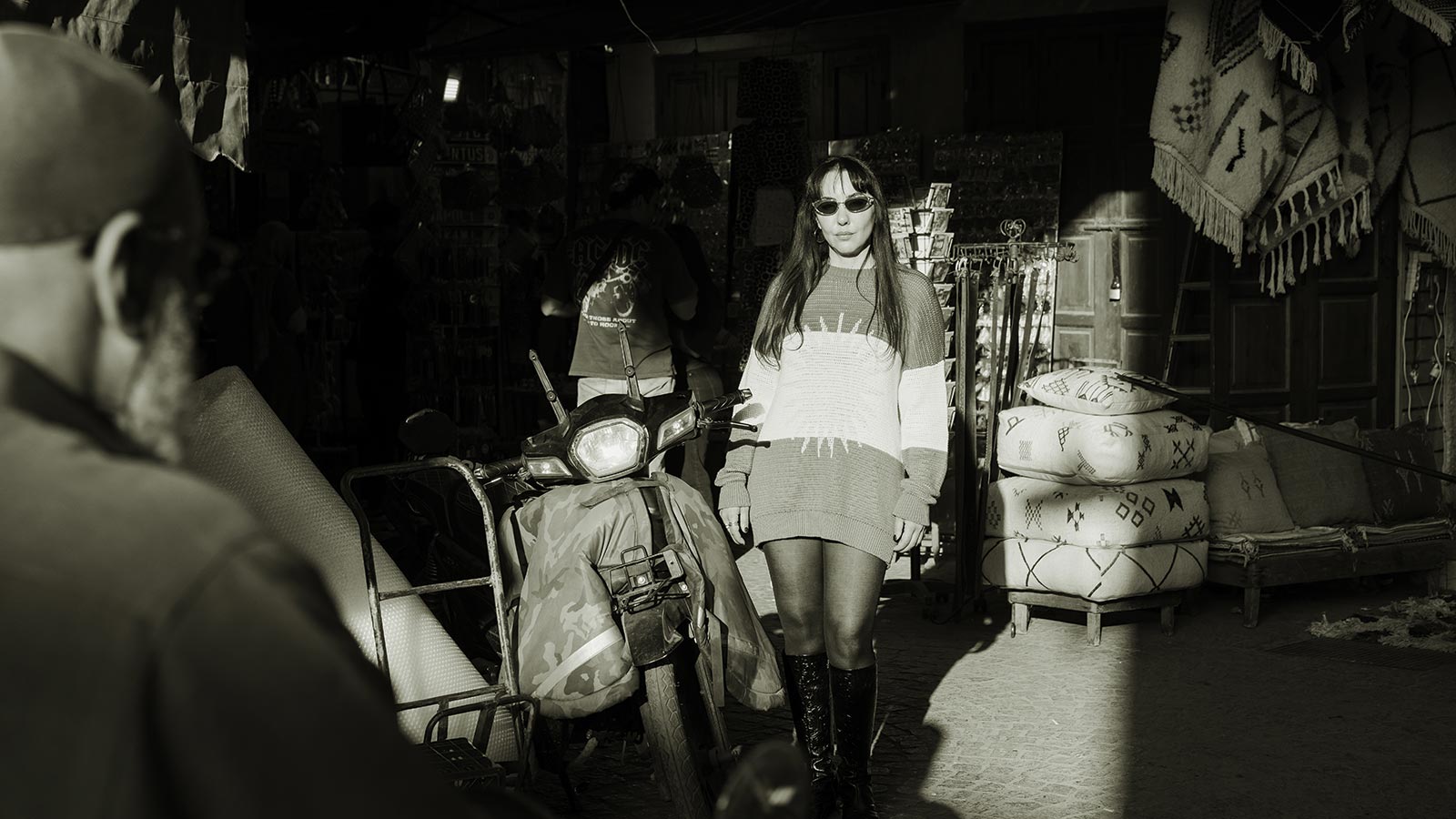
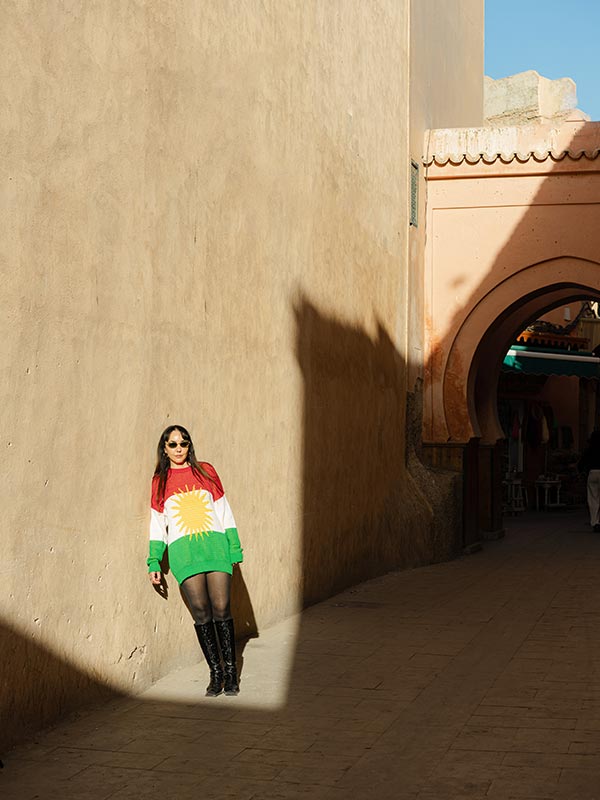
She plays music of the future: Seba Kayan combines techno beats with oriental elements to create wonderfully danceable sounds that defy any strict genre classification. The Viennese with Kurdish roots not only whets the appetite for endless club nights, but also questions our perception of music. Why is Western music considered neutral and why do we call everything else world music? The music producer and DJ explains in an interview. She also reveals what goes on her own party playlist, when she discovered her love of music and how she perceives the music industry as a woman.

FACES: Which song – one of your own or one by another artist – would you play to introduce yourself to someone who doesn’t know anything about you yet?
Seba Kayan: I would actually play my own song “Tencere” because it combines a lot of elements that define me. On the one hand there’s a Middle Eastern sample that’s been heavily processed through various filters, and on the other hand there are techno and acid sounds. The samples are exactly what they are: Excerpts, excerpts that never show the complete picture. The techno sound is a fluid bridge to club culture, which has had a strong influence on me.
F: Music reveals a lot about a person, but not everything. If you still have questions after this song: What should people definitely know about you?
SK: My song “Tencere” translates as “pot”. What you should know about me is that I myself am also a melting pot of different cultures and musical styles that are constantly bubbling inside me and influencing each other.
Q: What were your first points of contact with music?
SK: My first contact with music was through my father at an early age. He often literally “forced” us children to listen to concerts and cassettes. Even if we didn’t feel like it at the time, we would still sit in the living room and listen to recordings by Kurdish, Turkish and Armenian artists. Outside of home, I had classical music lessons that had little to do with the sounds from home. This discrepancy – but also the simultaneous abundance of musical worlds – had a strong influence on me and raised questions early on, for example about the division into so-called “high” and “low” culture and what constitutes the cultural canon.
Q: And was techno the genre that attracted you right from the start?
SK: Techno wasn’t the genre that attracted me from the beginning – but the idea behind it was, because it’s much more than just 4/4 on the floor. It’s a culture that came out of the Black culture community and the need for resistance, and a need for safe spaces. The club was a place where you could immerse yourself in another world, be anonymous and move freely – musically and physically. Now DJ and club culture has changed massively: DJs are increasingly becoming a product and the dancefloor a performative space in which the set is documented in real time. In the past, DJs were not visible at all, it was primarily about the community, now the DJ is the center of attention and performs.
F: In the music video for your first single “Tencere”, a group of women dance in a hammam. Combining techno sounds with a spa seems unusual at first glance, but it works perfect. How did you come up with the idea?
SK: For women from the Middle East, places like the hammam are sacred spaces. They always have been. They are still places of encounter, meeting and self-care. Meeting there means not only washing yourself, but also exchanging ideas as women in a safe environment. My mother often took us to the hammam. There, the daughters and mothers could move freely, away from the attributions and projections from outside. In my music video, I brought the club into a safe space for me – the hammam – surrounded by the coolest women from Vienna.
F: The music video also shows women who are among themselves, but who take up space and present themselves differently than you would perhaps expect from them in context. Do you also see parallels in this to how your music and you as an artist are perceived? Do you often have to deal with prejudices?
SK: One of the aims of my music video is to reframe a so-called “orientalist” and exoticizing image of women and to question and deconstruct our own prejudices, images of femininity and ascriptions of gender roles. There are of course parallels to my life. The self-perception and external perception of me as a woman, as an artist, as a second-generation Viennese woman with Kurdish roots is diametrically opposed to how I see myself. “Oriental” ideas and concepts are projected onto me, some of which have nothing to do with me. I have and have always had difficulties with concepts such as being “Kurdish” or “Viennese”. For me, identities are fluid and manifest themselves in many different ways.
“Western music theory is not objectively superior, but the result of power, colonial history and cultural enforcement.”
Q : How do you feel about the music industry as a woman?
SK: According to Forbes, the percentage of female producers is about 2.8 percent, an even smaller percentage of which are Women of Color. This imbalance is definitely noticeable and visible. As a woman, I definitely find this clear imbalance worrying. For me personally, the music scene in Vienna and internationally has always been very supportive, such as Radio FM4, which was the first to play my music and my sets and immediately understood my message. So big shout out to Functionist and FM4 Unlimited.
Q: What was the moment when you realized: My music is not only danceable, but also political?
SK: Before I started making music, I asked myself what I wanted to achieve with my music and what the message should be. The aim of my sound from the very beginning was to be danceable and at the same time to question the way we listen. Because disruption begins on the dancefloor, in the body and in the way we listen.
Q: To what extent is a Kurdish woman read differently in the techno scene than a white male DJ?
SK: The electronic music scene worldwide is still very much dominated by white men, that’s for sure. This is also visible on the line-ups of the big festivals. I don’t think I’m read as a “Kurdish” woman in the techno scene per se, but that women are generally read differently to male DJs. Women are confronted with different projections and prejudices in the scene than men.
Q: Is that why you have to prove yourself morethan others in the industry– or rather explain yourself?
SK: The music industry is a rollercoaster of people you meet: Bookers, festival organizers, who have different expectations and projections of and into you. I certainly had to prove myself and explain my sound more than others at the beginning. Male DJ friends even said at the beginning: play something else, your sound is too “folky”. Many had never heard this combination of middle-eastern samples with techno and acid on the dancefloor before, because the mainstream plays a different sound. I’m niche, and that’s my superpower.
Q: Which narratives about Kurdish women would you like to destroy?
SK: Basically, I don’t want to destroy anything, but rather put one-dimensional narratives in the right light, such as the image that shows Kurdish women predominantly as fighters. This image is strongly influenced by the Kurdish Women Fighters in Rojava, who fought against DAESH (IS – Islamic State, editor’s note), among others. As a result, Kurdish women are often either heroized or exoticized – as strong, armed symbols of resistance – while their complexity remains invisible. What is lost are their different realities, their intellectuality, their care, their contradictions, their creativity and their everyday struggles.
F: On your website, you write that although music is often described as a “universal language”, this is actually not true, because culture and tradition shape it. And the music theory we learn is shaped by the Western world view and music. Would you like to elaborate on these thoughts? How would you explain this to someone who hasn’t yet learned about it? has given it any thought?
SK: Music is not a “universal language”, because music always arises from culture, from history, from tradition and from social spaces. When we talk about music theory in Europe, we learn the Eurocentric scales and notation as basics. This system is often conveyed as neutral or universal, although it is only one of many. Other musical cultures work with completely different scales, rhythms, understandings of time or forms of music-making. In Turkish, Kurdish or Arabic music, for example, there are microtonal scales, so-called maqams, which of course sound different and are classified by European musicians as “world music” or “global sounds”. But what does “world” music mean? According to this classification, all scales from around the world should fall into this category. For someone who has never thought about it, I would explain it like this: Music is like language. Just because English is spoken worldwide doesn’t mean it’s the most “natural” or “correct” language. It has simply become historically dominant. It’s the same with Western music theory. It is not objectively superior, but the result of power, colonial history and cultural assertion.
“The aim of my sound from the very beginning was to be danceable and at the same time to question the way we listen.”
F: Your sound can be described as “oriental techno”. Do you like this term or do you think it creates too much of a distinction or picks up on clichés?
SK: When I talk about “oriental”, I am deliberately referring to the Palestinian cultural theorist Edward Said, who described the “Orient” as a Eurocentric construct – as a Western view of a geographical region, not as a self-designation. In the so-called Orient, nobody refers to themselves as “Oriental” or “Orientaline”. This shows that the term says less about the music or the people and more about the perspective from which it is viewed. The term “Oriental Techno” in this context is not descriptive, but discursive, in order to create discussion and reflection. But you don’t need to have inhaled Edward Said to know that the term “oriental” is problematic. In my music, I appropriate the attributions that are projected onto me from the outside and deconstruct them in my musical process.
Q: Why are western sounds considered neutral and others “ethnic”?
SK: The French philosopher Jacques Attali wrote in his book “Noise: The Political Economy of Music”: “What is called music today is all too often just a mask for the monologue of power.” Western sounds are often considered “neutral” because they have been declared the norm for centuries. Through colonialism, cultural hegemony and global power relations, Western music theory has been established as the standard. Anything that deviates from this is automatically marked as “different” – and therefore “ethnic”. True to the motto: “The West – and the Rest”. The term “ethnic” says less about the music itself than about the perspective from which it is viewed. But from which perspective are we looking at this terminology? While a string arrangement or a 4/4 beat is rarely culturally localized, non-Western sounds constantly have to “explain” their origin and are pushed into categories.
Q: Is it still appropriate to categorize music into different genres?
SK: I think the question is not so much whether genre categories are still contemporary, but what we use them for. Genres once created a kind of orientation for listeners and provided a common identity. Today, however, they often seem like rigid pigeonholes. Sometimes people ask me whether I produce techno, house or tech house, deep house or melodic house. My sound can contain all elements without being pigeonholed into one genre. Music is by no means created in a linear way or within clearly defined traditions. I move between genres, draw inspiration from different contexts and cultures and mix influences. That’s exactly what defines me in principle. It becomes problematic when genre designations not only describe, but also evaluate or limit – for example, when certain sounds are read as “ethnic” “world” “global” and others as neutral or universal.
F: You have European and Kurdish roots. To what extent does this dual location change your view of music, power and belonging?
SK: I think what had a strong impact on me is the fact that there is no country “Kurdistan” on the map and officially. With 30 million Kurds, it is the largest diaspora in the world and therefore the largest nation without its own state. My father always said that we are the country of the future because we don’t believe in borders. I always joked and replied: “You only say that because we don’t have our own country”. This feeling of not belonging 100 percent to any country, but still feeling connected to many countries, has really shaped my view of music, power and belonging. It gave me the freedom to move between borders and cultures without defining myself as something or through a nationality.
F: When did you first realize that you were growing up with two very different cultures? How do you mix the two cultures together – personally, but also in your music?
SK: I think I first became aware of this at school. The realities of my friends’ lives and weekends were different to mine. While they went hiking in the mountains at the weekend, we had family visits and community events on the agenda. In my music, I mix precisely these elements, which at first glance don’t seem to go together, like middle-eastern samples with techno, but which actually harmonize wonderfully, like hiking and family visits.
“Music is not a ‘universal language’, because music always arises from culture, from history, from tradition and from social spaces.”
F: You hold workshops on the topic of “Decolonize Electronic Music”. Where in electronic music are Western norms and colonial thinking to be found? And how can we open our eyes?
SK: For me, opening up the view primarily means making colonial structures in music theory visible. To understand that – electronic – music is not a neutral playground, but is embedded in social power relations. My workshops are about questioning listening habits: why do we perceive certain scales as “dissonant” and others as “harmonious”? In my workshop, you learn to create your own scales and to make music with them in a very concrete way. Why? Because you can! The world consists of more than twelve notes. It’s not about getting everything “right”, but about listening more consciously and, of course, becoming aware of the fact that music theory itself is predominantly structured by Eurocentric, white perspectives, which is also visible in music theory textbooks, because over 97 percent of them consist of examples of white, male composers. This knowledge is conveyed as universal, although it only represents a very specific cultural section.
F: Is there a limit to cultural appropriation somewhere? For example, when someone incorporates oriental sounds into their music without having any connection to this culture. Or do you also see this as an opportunity for a more diverse music industry?
SK: A clear example of cultural appropriation in electronic music is “Afro House”. Here, white, male producers often use a cultural heritage to which they have no personal connection as a matter of course. Afro-diasporic sounds are aestheticized and commercialized, while the artists and scenes from which this music emerged remain marginalized or are not even acknowledged. So the problem is not cultural exchange per se. Music has always been hybrid and in dialog. It becomes critical when recognition, money and visibility end up with those who are already privileged, while others are reduced to “inspiration”.
F: You incorporate the Kurdish tradition of Dengbêj, a musical form of storytelling, into your sound. Tell us more about it.
SK: The word dengbêj comes from Kurdish: “deng” means voice, “bêj” means to tell or speak. A dengbêj is therefore literally someone who “tells stories with their voice” – a voice-teller. Dengbêjs are singers and storytellers at the same time. The Kurdish language was officially banned in Turkey for decades, meaning that Kurdish history, language and culture were suppressed for a long time. During this time, dengbêjis were literally the keepers of stories and memories. They transported a collective knowledge exclusively through the voice – usually without instrumental accompaniment. They were therefore living archives. My grandmother was a dengbêji. She used to sing us normal stories from everyday life, which I loved. As a child, I wasn’t aware of the history and meaning behind it. It was only later that I understood that singing was a coping mechanism for her – and for many others: a way of dealing with collective trauma, processing pain and making experiences audible for which there was often no space. When I incorporate this tradition into my music, I don’t see it as a folkloristic quote, but as a concept. The idea of the voice as an archive, as resistance, as a carrier of history, especially the story of my grandma Gare, which I have often sampled.
Q: What other artists inspire your sound?
SK: I draw a lot of references from the diaspora culture, so pioneers like Selda Bağcan, Omar Suleyman, Sezen Aksu, Siwan Perwer but also from the electronic scene like Juan Atkins, Theus Mago, Kerala Dust and many more.
Q: If you had to make us the perfect party playlist, what would be on it?
SK: My party playlist would definitely include everything – from Madonna to Sezen Aksu, with techno in between and of course my own songs.
F: The world situation doesn’t exactly call for a party at the moment. And yet music helps us in difficult times. Do you notice that people are perhaps longing to let go and enjoy the beats more at the moment?
SK: The word “party” has almost become a non-word in our dopamine-driven, escapist and over-staged society. Yet community events where people danced have always been part of the reality of our lives. The difference today is often the motivation: to “shoot out” of the body instead of connecting with it. There are countless studies that describe dancing and singing as somatic healing practices. That’s why I invite everyone to make their own “party” playlist, because it instantly lifts your mood and helps your mental health. This is especially important in times like these.
Q: How does music help you deal with challenging situations in life?
SK: This always sounds a bit trite when I say it, but when I listen to music, produce electronic music or simply chant to mantras in my Kundalini class, I connect with something higher than myself. I can free myself from my prefrontal cortex – even if it’s only for a short time.
Q: What genres of music do you like apart from techno?
SK: I listen to a lot of classical music, pop and some hip-hop.
Q: Who would you really like to record a song with?
SK: If she were still alive, with Oum Kouthoum.
F: You are also a lecturer at the Academy of Fine Arts in Vienna. What topics would you most like to teach there?
SK: Above all, I want to raise awareness of the fact that listening never takes place in a vacuum. How we perceive, evaluate and classify music is always shaped by social, cultural and historical norms.
Q: How do you see the future of the music industry?
SK: I think it’s going to be exciting. On the one hand, the use of AI in music production will continue to increase. Production processes will be accelerated, aesthetic standards will become more reproducible and access to musical tools will be further democratized. At the same time, AI places questions of authorship, originality and value creation in a new context. I think the live experience, the unrepeatable and the situational will become more important, communities will not be defined by pure production, but by the contexts, relationships and content that music enables. At least that’s what I hope.
F: And where do you see your own future? What’s on your bucket list?
SK: There’s a lot on my bucket list. But as we Alevi Kurds say: Don’t jinx it before manifested.
Seba Kayan
Music is more than just a collection of melodies that tickles the entire range of emotions out of us, from euphoria to tears – it is political. Austrian-Kurdish DJ Seba Kayan learned this as a child. Her music mixes oriental elements with techno and acid sounds, bringing listeners to the dancefloor on the one hand and making them think about Western norms, culture and tradition on the other. Her latest single “Zurna Rave”, which mixes a Kurdish song with the traditional instrument zurna with techno, also aims to encourage music fans to question their listening mechanisms. sebakayan.com
Speaking of music: Lady Gaga recently turned 40, so we’ve dedicated a portrait to the ultimate icon.
Stay up to date with Seba Kayan and her sound.
Photos: Omar Ch-Hibat, Emilia Milewska