
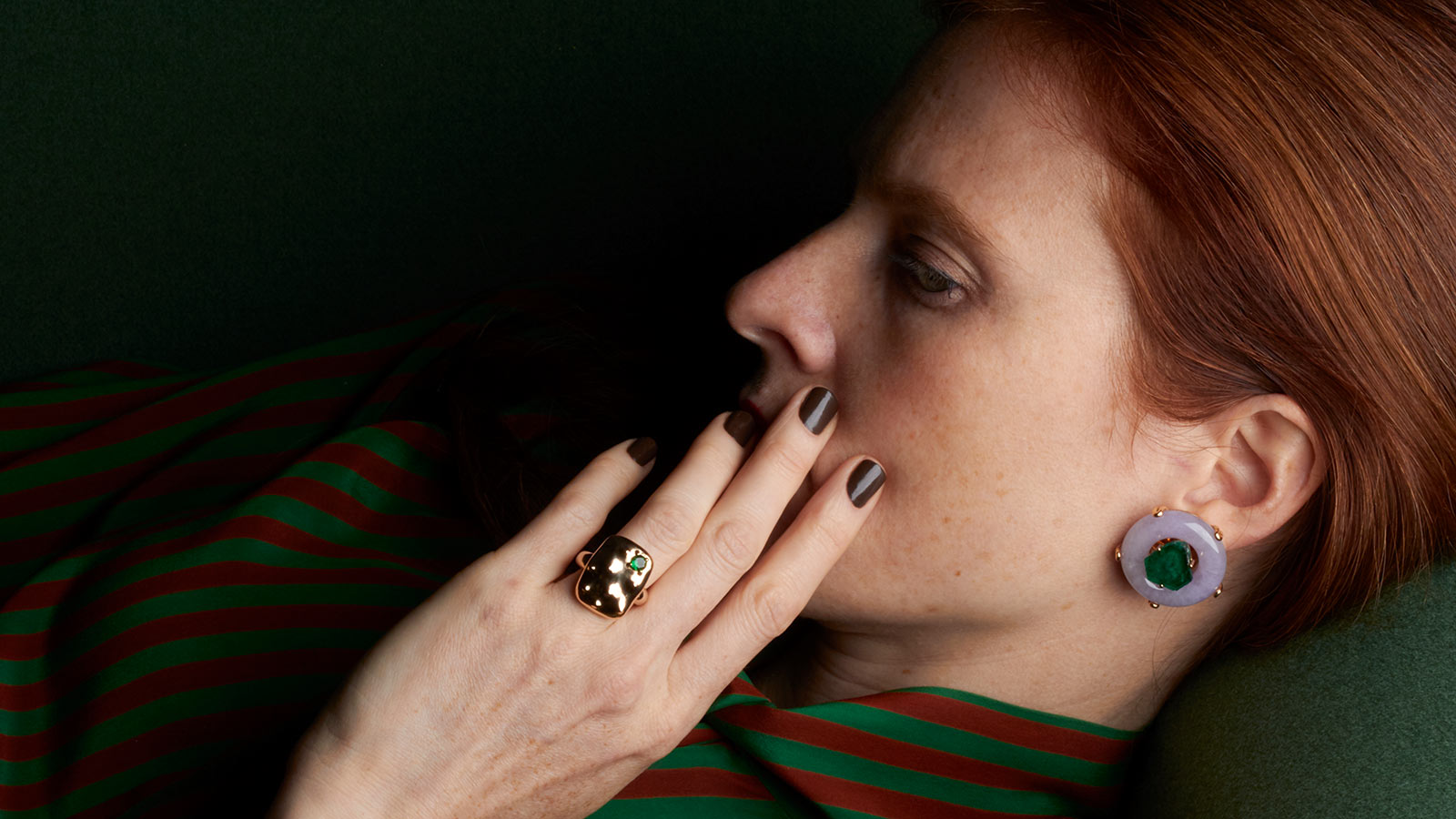
Rising gold prices, general doomsday mood: how do you survive in the world of high jewelry? By doing everything differently. No one knows this better than Cora Sheibani. The Swiss designer creates the way she wants. And in doing so, she not only retains the joy of her work, but has also gathered a loyal clientele over the decades. This year, her jewelry pieces were shown at the renowned TEFAF art fair in Maastricht – a masterstroke only achieved by select designers. In conversation with FACES in Zurich, she brought jewelry with her, talked about her latest ideas and philosophized about prejudice, AI and the future of her industry.
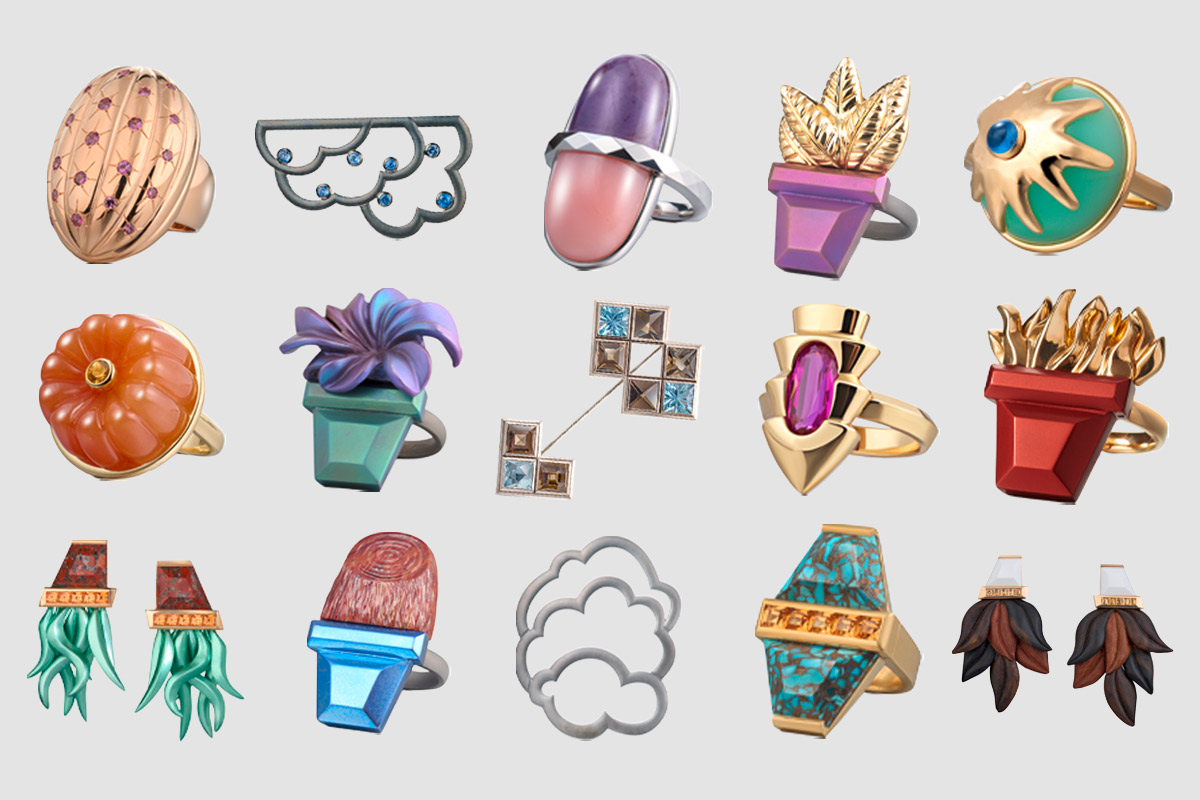
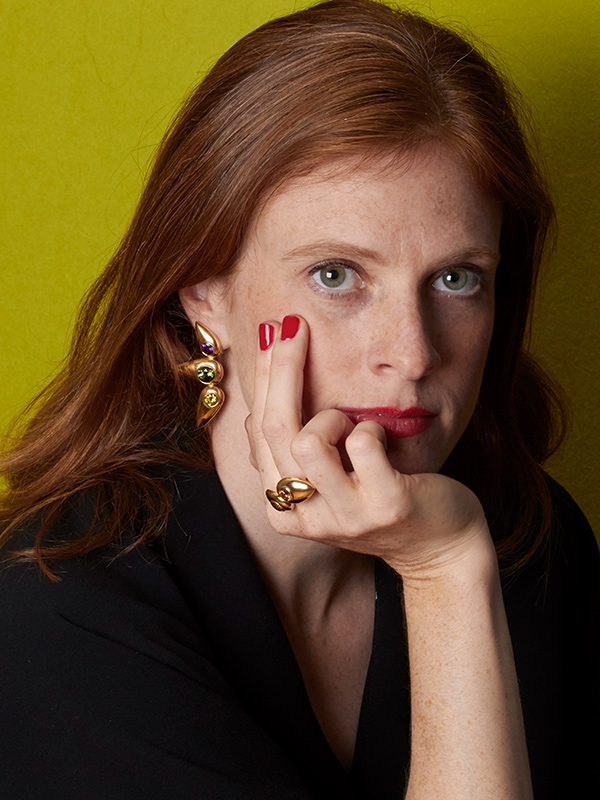
It’s not that easy to get up close and personal with expensive jewelry. Not even if you deal with it professionally. In the stores, security watches at the entrance and keeps a close eye on even the wealthiest customers. Even when they pull out their credit cards without batting an eyelid to add to their own jewelry collection. Cora Sheibani does things a little differently. The Swiss jewelry designer has created her own rules over the decades. She doesn’t turn up for a meeting in a Zurich café with security in tow, but with a selection of her own jewelry, which she spreads out between croissants and cappuccinos during the conversation. For example, a small ring in the shape of an eye and her large, heavy “butterfly” earrings made of gold, both from the 2017 “Eyes” collection. The ring belongs to a customer who would like to have it enlarged. A difficult undertaking. “I should actually make a new ring,” says Cora. But her work thrives on such requests and custom-made products, as each of her pieces is unique. If someone wants a pair of “butterfly” earrings, they are made to order, which means the colors can vary. Even though she always has pieces in stock that can be ordered, the designer does not mass-produce seasonal collections with all the trimmings.
Cora Sheibani founded her eponymous label in 2002. Instead of focusing on constant growth and, as the big houses do, producing collections with the same structure and in large quantities, she creates on a whim. And always with one foot in the art world – which is where she comes from. Cora studied art history at New York University, followed by a degree in gemology in London, where she still lives today. Her childhood was also shaped by art: Her father Bruno Bischofberger is a renowned art dealer, so her childhood was characterized by direct contact with artists and creativity. This year, some of Cora’s pieces were exhibited at TEFAF (The European Fine Art Fair), one of the most important art fairs, in Maastricht. She had to apply for a stand herself. After an initial rejection, she was offered one after all. The committee that decides who is allowed to exhibit in the jewelry section at TEFAF is made up of other jewelers or jewelry dealers. Cora was therefore recommended by her colleagues. This sealed her status as an artist even more.
Old and new gold
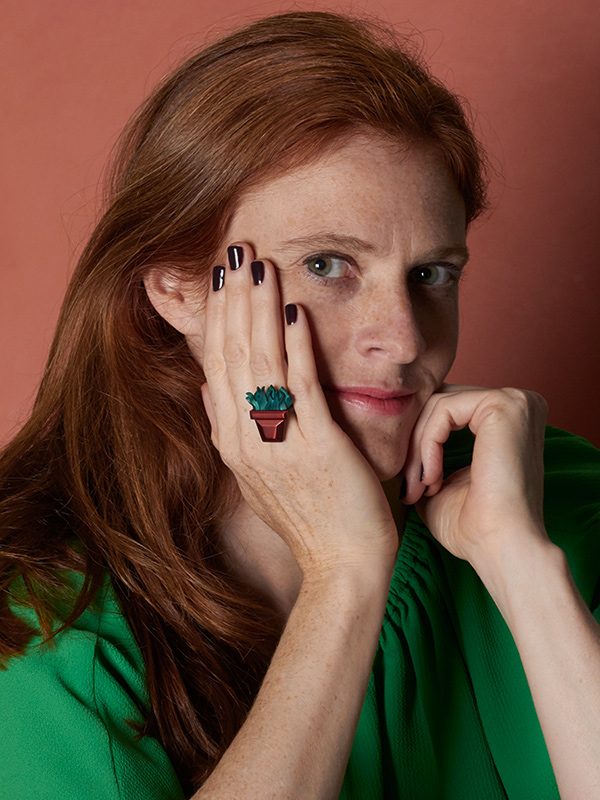
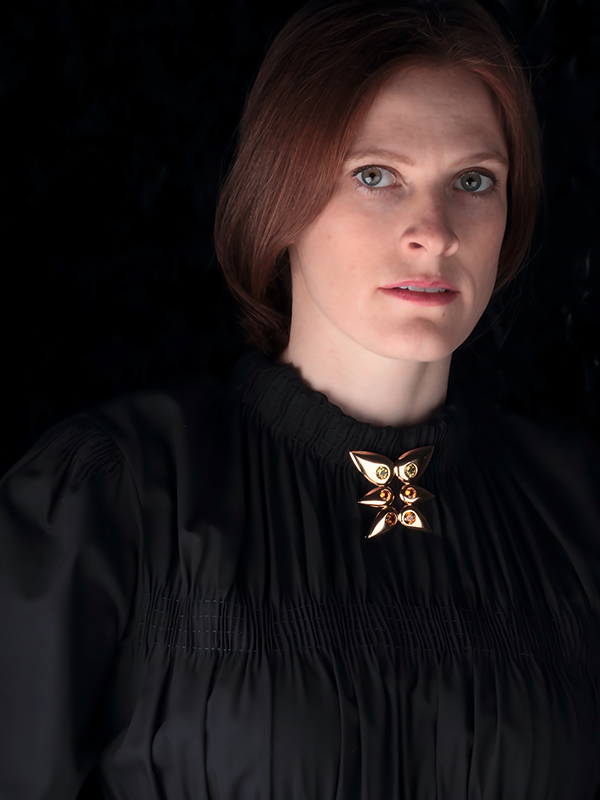
Cora started collecting historical jewelry as a child. “I love jewelry more than anything,” she emphasizes again and again during the interview. But that doesn’t mean she sparkles from head to toe. Cora sets accents with intention. A ring here, a necklace here. “The first piece of jewelry I ever designed was a brooch. So I’ve always worn brooches,” says Cora and pulls out one from her “Facets & Forms” collection. “This is a jabot brooch. It’s made up of two parts, Cartier called it a cliquet,” she explains as she attaches the brooch to her cardigan, demonstrating how the two parts become a single piece. “I’m basically my own billboard,” says Cora when asked what kind of jewelry she wears. That’s why she mainly wears her own. In fact, Cora often models herself when it comes to visually showcasing a new collection. Or even part of her family. She once did a photoshoot with her daughter, for example, where her youngest son wanted to be there too and got dressed up. If it’s not one of her own creations, Cora wears historical jewelry. “I look at old jewelry non-stop, I also love the science behind it, the history of the stones,” she says.
When it comes to materials, Cora quickly gets going. Over the years, she has acquired a wealth of knowledge. But before she dives into the world of precious metals, a linguistic digression: in French, there are different names for jewelry: joaillerie and bijouterie, both pretty words, but they don’t mean the same thing, as Cora had to learn at the beginning of her career. “I once wanted to find producers in Geneva. At the beginning I couldn’t afford diamonds, but I still wanted good quality,” says Cora. “Then I was told that I would just make bijous and they would make joaillerie. Joaillerie is gemstones, bijouterie is gold jewelry and creative jewelry. I asked myself: why is one better than the other? Just because I don’t want expensive stones doesn’t mean the quality should suffer”. Cora remains true to this principle to this day. Many people are now adopting this way of thinking. Cora draws a comparison with the fashion industry: “Nowadays, there are more people who will spend more money on a simple shirt because they value materials such as organic cotton. It should be the same with jewelry.”
Crises create creativity
The fact that gold prices are rising rapidly at the moment doesn’t bother Cora much. “There are those who really look at the money and those who are more artistic,” she explains. “I’m somewhere in between. My main customers are people who have a lot of money,” she says with a mischievous laugh. However, such customers are often concerned that their jewelry doesn’t stand out too much and that you can’t tell at first glance how expensive it is. She picks up the heavy “butterfly” earring again, which is made of lots of gold. “Every time I make a new version of this model, it gets more expensive. Just because of the gold. But I still sell them,” says Cora, adding: “For the people who can afford it, a 20 or 30 percent surcharge isn’t that important.”
Price changes in precious metals stimulate creativity, because sometimes you have to try something new to keep prices from skyrocketing. Instead of despairing, Cora describes it as follows: “We all have to dance a little differently. You have to approach every difficulty creatively and differently instead of complaining. In precious metals, this means that platinum is increasingly being used, which is cheaper than gold but comes with its own hurdles. “You can pull a gold plumb bob, move it quickly, it has so many amazing properties,” enthuses Cora. Platinum, on the other hand, requires more experienced and skilled hands: “You need different tools, the heat is much higher. While gold solder can be melted slowly like chocolate, platinum solder can only be completely liquid or solid, with no intermediate stage. This requires a lot of skill and experience during processing.”
“People will always wear jewelry, no matter what.”
From precious metals to precious stones. Cora’s “Facets & Forms” collection, full of geometric shapes and colored stones, has a special feature: each stone is cut differently. “This one is a context cut, this one is a step cut,” explains Cora, holding an earring up to the light to show that the different cuts even give the gemstones slightly different shades of color depending on how the light falls on them. Playful design with cuts, colors and different stones requires knowledge that you don’t just acquire: “I wasn’t trained as a goldsmith, which means that at the beginning I didn’t know what was possible and what was not. Today I know a lot more,” says Cora and adds: “There are still things I’m learning. That’s the great thing about it. The world is changing, I’m always learning new things”.
Cora has long since become a professional herself. She works with selected goldsmiths to turn her colorful ideas into reality. “A drawing is sent to the goldsmith. Then a prototype is created in wax, or details are added to the drawing,” she explains the creation process. Thanks to digitalization, this process has become faster. Whereas in the past, people used to laboriously fax back and forth, today a lot of things are done via WhatsApp when she is not in the country. Regular trips to Switzerland are still on the agenda. Cora develops with a few select people. One of her goldsmiths has just retired in France and two work in Switzerland. “I develop with them. There are more on board for production,” says Cora. Production still takes place mainly in Switzerland, and occasionally also in Italy and France.
Pearls for all
“I actually want to do something new now,” says Cora, talking about her current collection “Skin Deep”. For her, new sometimes also means immersing herself in a previously unknown world of materials, such as the world of pearls for “Skin Deep”. A natural wonder that fits in perfectly with Cora Sheibani’s colorful design language, because pearls don’t just come in a whitish sheen. “Freshwater mussels from China make copper and purple pearls, in the South Seas they are golden and black, in Tahiti light gray and green, in Japan very light, pink or white,” explains Cora, who has long since become a pearl professional. “I couldn’t choose one color, so I chose them all,” says Cora, who keeps falling back into English during the conversation. She has lived in London for a good two decades. Her husband speaks four languages, but no German, and although she used to speak Swiss German with her children, “my older son sounds like a three-year-old,” she says and laughs.
Working with pearls has made Cora think about prejudices. “When it comes to pearls, people quickly become judgmental, even really snobbish,” she says. Most people immediately have an opinion, preferring a cultured pearl from the South Seas to one from China, for example. Cora doesn’t take such a narrow view: “Everything is allowed in the jewelry industry, but you have to declare it,” she says. So you just have to be open and honest about what materials you use. She has mixed different beads together. “You don’t actually do that because one is much more expensive than the other,” says Cora. “A pearl may or may not be enhanced, its color may have been changed, but that doesn’t matter – just enjoy it,” she says. The preconceptions about the nature of pearls, whether natural or cultured and from which corner of the world they originate, finally led Cora to the name of the collection: “Skin Deep”. An ironic term in English to describe something superficial. Something that doesn’t go much deeper than the skin. “The way people judge pearls is the same way they judge human skin: is it Botox, filler, does it make you look old or not? Maybe I’m getting older too,” says Cora, half-critically, half-laughing.
“I love my design process”
“I love my design process,” says Cora. It works because it is not dictated by trends. Over the last twenty years, a recipe has emerged that is not only radically different from the big jewelry houses, but also watertight: “If I design what I want to wear myself, then that’s what works best”. So Cora thinks about what she doesn’t have yet, or what she hasn’t done for a long time. At the last coronation, which Cora watched as an Englishwoman by choice, she thought: “I’ve never made a tiara before. I’d also love to make a medal one day. Or a shoulder brooch.” She did eventually make a tiara – for the coronation of Charles III, at which the guests were asked not to wear a tiara for the first time. Shoulder brooches and medals are still on her to-do list.
Even though Cora’s creativity knows no bounds and extends into the world of the monarchy, there are basics that always work. Rings and earrings are the best sellers, although earrings are still a relatively new piece of jewelry in the western world. Necklaces, on the other hand, sell less because they are now too expensive. You can tell that the affluence and prosperity of society can also be seen in pretty luxury happiness-boosters such as jewelry.
The future is handmade
In a world that is gradually being dumbed down by AI, creative craftsmanship still seems to be one of the last refuges where you don’t hand over your work to the supposedly smart machine. But AI is also finding its way into design. Cora doesn’t think much of it: “Sure, AI can design great jewelry for me, but it doesn’t know whether it can be implemented,” she says. As a designer, Cora has to think more three-dimensionally than a machine can. To do this, she applies knowledge that she has acquired over decades of practical experience. “I also have to think about the future: how can I repair the piece if it ever breaks? I can do that thanks to years of experience,” she adds. “Someone can give me a drawing”, says Cora, “and I can make it a reality”. How nice that ChatGPT can’t do that. “I’m not afraid that someone will take my work away from me,” says Cora. And she doesn’t have to be. Because no AI can come up with the charm and unconventionality that Cora uses to come up with her ideas. For decades, Cora has exemplified that you have to find your own corner for success and not constantly think about what’s on trend. This is exactly why her label works. “Every time I do something just because it’s trendy, it’s a mistake”, she says, “but we all make mistakes”.
So Cora is anything but gloomy about the future. “People will always wear jewelry, no matter what. It’s part of our human nature, part of every culture, no matter how rich or poor people are,” she says. The only problem is that there are more and more people, but jewelry is limited. That’s why a unique piece is worth more than something of which there are 50 copies. So it’s worth it, Cora still only makes unique pieces. “Jewelry will always be more expensive, but there will always be a market that appreciates it,” says Cora. But she doesn’t want to plan too far into the future: “I just do what interests me,” she says. “And hopefully one day I’ll become the new collector’s item,” she adds and laughs. That’s a pretty realistic idea in a world where genuine craftsmanship and creativity are becoming increasingly rare commodities.
Cora Sheibani
If you don’t know what the English word whimsical means, you will not only find the answer in the dictionary, but also in Cora Sheibani’s designs. They are wonderfully whimsical, colorful, whimsically charming and full of joie de vivre. Her designs include the traditional Swiss pastry Gugelhupf in the shape of a ring, colorful pearls and earrings that together form the silhouette of a butterfly. Cora lives in London, but regularly returns to her Swiss homeland, among other things to exchange ideas and produce with her trusted goldsmiths. corasheibani.com
Choose your new favorite piece of jewelry.
Photos: © Cora Sheibani
We have more beautiful sparkles in stock here.