

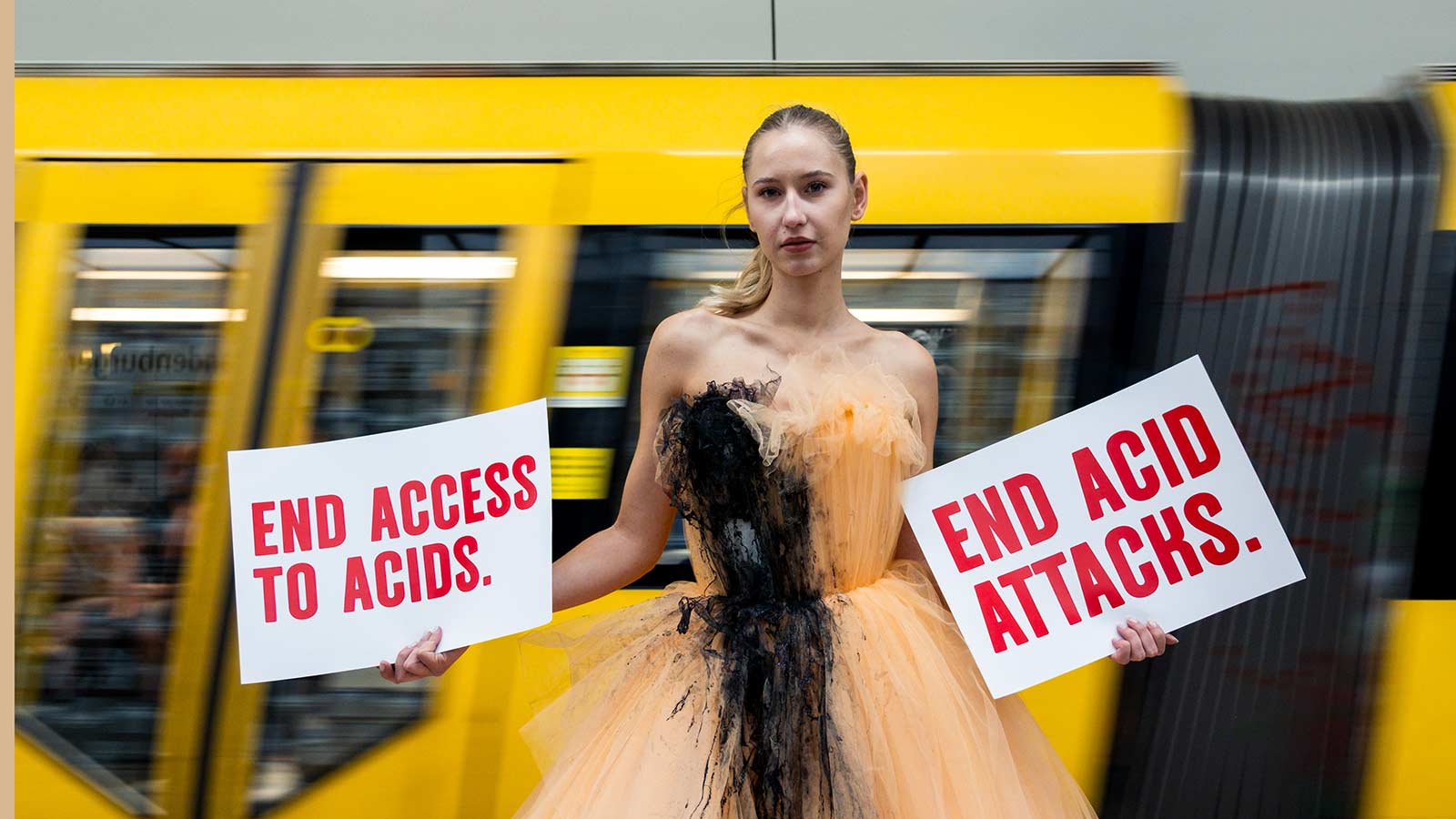
Berlin Fashion Week: In the midst of the hustle and bustle surrounding catwalks and new collections, a performance draws attention to a problem that is seldom associated with the fashion world but is directly related to textile production – acid attacks.
The silent reminder in pink
Summer. Berlin. Fashion Week – everything revolves around aesthetics, cut constructions and silhouettes. But while models walk the catwalks, something unusual happens outside the doors of the highly frequented fashion shows by Richert Beil, Marc Cain, Haderlump Atelier Berlin and Kilian Kerner: a blonde woman in a pompous, pink dress stands motionless in the crowd. The left side of the elegant fabric has a large black stain running through it, making it look tattered, almost burnt. In her hands she holds white signs with red inscriptions such as “Easy to Access. Easy to Throw.” or “Acid that scars for life.”
The model in question is Daniela Suttrop. She is part of the “End Acid Attacks” campaign by the British NGO ASTI (Acid Survivors Trust International). Her goal: to draw attention to a taboo crime – and the role that the fashion industry plays in it.


Fashion must not leave scars
Over 10,000 acid attacks are documented worldwide every year, but the number of unreported cases is uncertain. “Many countries do not have specific laws to record such acts. For fear of retribution or a lack of trust in the police and justice system, many cases are not even reported,” says Fatma O. on behalf of the organization.
Figures from countries with corresponding laws:
- United Kingdom (2024): 464 reported attacks, around two thirds of those affected are men.
- India (2021): around 200 cases, two thirds of them women and girls.
- Pakistan: also around 200 cases a year, 85% of them in the province of Punjab – known as the “cotton belt”. The Acid Control Act was passed there in 2025.
The phenomenon has also been documented in Italy, Uganda, Iran, Jamaica and Mexico – “it’s a global problem that occurs regardless of culture or continent,” says Fatma.
The connection to the fashion industry
Many of these countries produce a large proportion of our clothing. Highly concentrated chemicals often lie around unsecured in textile factories. What is actually intended for dyeing fabrics can become a weapon in seconds.
The “End Acid Attacks” campaign confronts the glittering fashion world with this uncomfortable truth and is a painful reminder of what fashion can really cost.
ASTI is currently examining similar campaigns in Paris and London. However, EU directives on sustainability reporting and due diligence have been postponed until 2027 at the earliest – a setback for all those who want to encourage companies to be more transparent.
According to the Pulse of the Fashion Industry Report from 2017, the use of chemicals remains one of the “least transparent areas” of supply chains. 43 million tons are used in textile production every year – often without sufficient safety standards.

Acid attacks as patriarchal violence
These acts are often seen as gender-specific: retaliation against women who have said no – to a man, to a marriage, to sex.
Victims of acid injuries suffer from extensive scars, lifelong pain, blindness, social exclusion and shame, which should actually affect perpetrators, not victims. In the absence of medical care, many die as a result.
The intention of the perpetrators: not only physical injury, but also the destruction of social and economic prospects by stigmatizing the survivors. International courts now classify acid attacks as acts of extreme cruelty and torture.
This is what ASTI demands
“The industry must take responsibility,” says ASTI Director Jaf Shah.
In concrete terms, this means:
- National recording and monitoring of acid attacks
- Risk assessment along the supply chain – including chemicals management
- Access to medical and psychological care for survivors
- Consistent prosecution of offenders
- Safety standards and training for factories and suppliers
- Partnerships between fashion companies and NGOs
Reactions from the labels in front of whose shows the campaign took place? None so far.
Knowledge saves lives – first aid for acid attacks
When an acid attack happens, every second counts. According to NHS England and the British Association of Plastic, Reconstructive and Aesthetic Surgeons (BAPRAS), the following steps are crucial:
REPORT: Dial emergency number immediately. Say “Acid attack” clearly. Do not hang up.
REMOVE: Carefully remove clothing around the affected area – without endangering your own skin.
RINSE: Rinse the affected area (especially face/eyes) with plenty of water – for at least 20 minutes.

You can find out more about the work of Acid Survivors Trust International on their website .
Are you looking for a brand that values ethically managed production? How about Moya Kala?
Photos: © A.S.T.I