
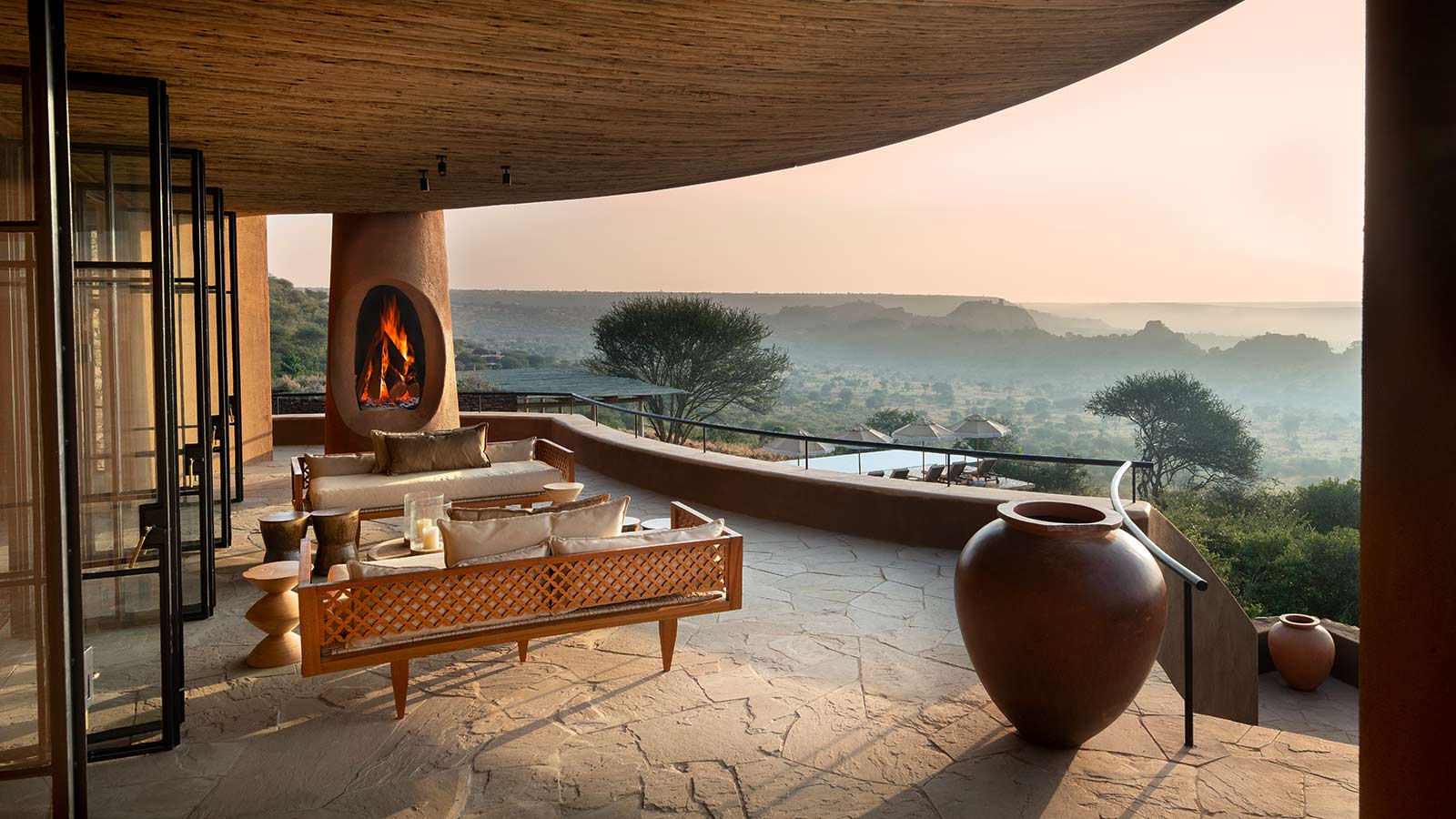
Here, the call of the wild becomes a whisper. Nestled within a 178-square-kilometer nature reserve, the Suyian Lodge stands like a waterbird perched on the back of a hippopotamus: gentle, quiet, and grateful for the tolerance of such a mighty host. Opened in 2025, this luxury resort with its 14 freestanding suites is the perfect base for exploring Kenya’s wildlife and landscapes. From African wild dogs in the wild to Downward Dog in the panoramic yoga room, this journey teaches us that where hardly a soul is to be found, the land reveals its own soul all the more.
Its coat is like a snowflake—absolutely one of a kind. The pattern of black, white, and caramel-blond hair makes every African wild dog unique. Experts can often identify individual animals at a glance. If you look closely, you can discern the landscape where the creature roams in the waves and patches of its fur. In Latin, it is called the “painted wolf.” In the languages of the Samburu and Maasai, it is called “Suyian.” But just like a snowflake in the dry savanna, the African wild dog’s chances of survival were bleak for a long time. When European ranchers settled in Central and Southern Africa at the beginning of the 20th century, they defended their livestock against attacks by these carnivores with their fingers on the trigger and traps in the bushes. Later, diseases such as rabies nearly wiped out this pack animal entirely. Yet, ironically, it was a descendant of one of those ranchers from the north who played a key role in ensuring that the largest wild dog on the African continent is now slowly spreading its range once again.
FROM COW TRADING TO THE ELEPHANT ROUNDTABLE
Not every love story begins romantically. This one, at least, has a unique beginning: Elizabeth Cross and William Powys met when Will found a pistol in a riverbed while riding through the Kenyan wilderness. He tracked down the owner and, in doing so, met the love of his life. Elizabeth, a former nurse during World War I, had lost the gun while hunting baboons. The monkeys had killed livestock and were therefore marked for culling. Powys’s family had emigrated from England to Kenya before the war, where William had fought on the African front against the guerrilla army of Prussian commander Paul von Lettow-Vorbeck. After their marriage, Elizabeth and William settled on the northwestern slopes of Mount Kenya and started a family, which included their son Gilfrid Powys. Some of the greatest conflicts in human history began when Great Britain showed up uninvited somewhere in the world and unrolled not just its beach towels, but an entire colonial empire. In Kenya, too, the English Crown claimed the fertile land in the Laikipia region and turned it into the “White Highlands.” The area was reserved exclusively for European newcomers, who established vast pastures for livestock there, thereby displacing not only the Maasai people but also the local wildlife. When Kenya gained its independence in 1963, numerous landowning families returned to their ancestral homeland. William, however, acquired the 178-square-kilometer Suyian Ranch and placed it in the hands of Gilfrid Powys. In the decades that followed, Gilfrid made it his mission to return the land to the animals that had originally inhabited it. The Suyian Ranch became the Suyian Conservancy. Where sheep and cattle once grazed for kilometers on end, elephants now once again trample through a landscape from which they had completely disappeared for over 50 years. Today, the Suyian Conservancy is one of the largest private nature reserves in Laikipia, where various animal species—including the African wild dog, after which it is named—have reestablished themselves. Tragically, Gilfrid Powys’s life’s work ultimately proved to be his undoing: in 2017, he was trampled to death by an elephant.
MILKING, FISHING, MARVELING
Anyone who wants to explore the wildlife of Laikipia doesn’t have to put themselves in danger. The Suyian Conservancy offers expeditions that gently and respectfully introduce guests to the wild. During the twice-daily (and twice-nightly) game drives, guests can spot leopards, impalas, hyenas, hartebeests, and other savanna inhabitants from the comfort of a Jeep. On guided hikes, you can experience the landscape up close and personal. Occasionally, rare plants—once meticulously cataloged by the enthusiastic amateur botanist Gilfrid Powys—brush past the trekking shoes of tour participants, while nearly raven-black cliff eagles circle overhead. Those who prefer to leave the legwork to others can join a guided horseback ride. Riding on the backs of the horses, you’ll glide along at the pace of the reticulated giraffes and Beisa oryx as they search the grasslands for their next meal. Boran cattle are still grazing in the Suyian Conservancy, even though their numbers have dwindled to between 2,500 and 3,000. The remaining ranching areas are no longer in conflict over resources but are now coordinated with the nature reserve. Visitors are invited to help drive the cattle out to their pastures. Among the indigenous peoples of Laikipia, dromedary herding has also played a major role for centuries. The Samburu herders use the one-humped camels for transportation and process them for meat and leather. Dromedaries are particularly valuable for their milk: unlike cows, the female camels continue to produce milk even during prolonged dry spells. Guests at the Suyian Conservancy can explore a traditional camel camp and try their hand at milking. Laikipia is home to wildlife that is often overlooked—probably because it doesn’t creep along the horizon on the earth’s surface. Beneath the waters of the Ewaso Narok River lies a silent underwater realm. African catfish, Sabaki tilapia, and African carp swim in the river, which winds its way through the region and brings its wetlands to life. On “catch-and-release” fishing trips, you can get a closer look at the fish without them ending up on your plate. For those who want to delve even deeper into Kenya’s aquatic world, a day trip to Lake Turkana can be arranged upon request. The world’s largest desert lake shimmers like a jade stone and, with its fossil finds dating back millions of years, is considered the “cradle of humanity.” For those who, after so many impressions, are eager to retire to their own beds, we’ll finally guide you through the gates of an extraordinary resort, tucked away in the Suyian Conservancy like a sleeping wildcat in the shade of a umbrella acacia.
IN THE COCOON OF THE SAVANNAH
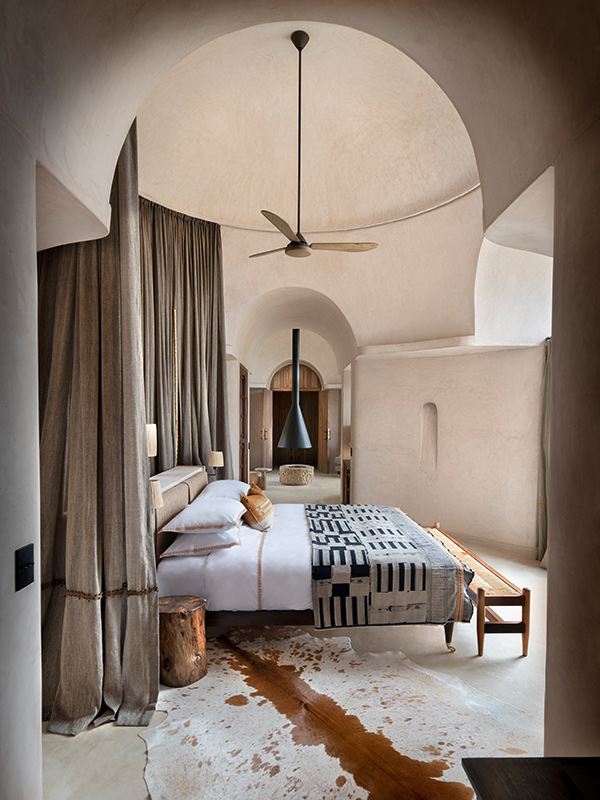
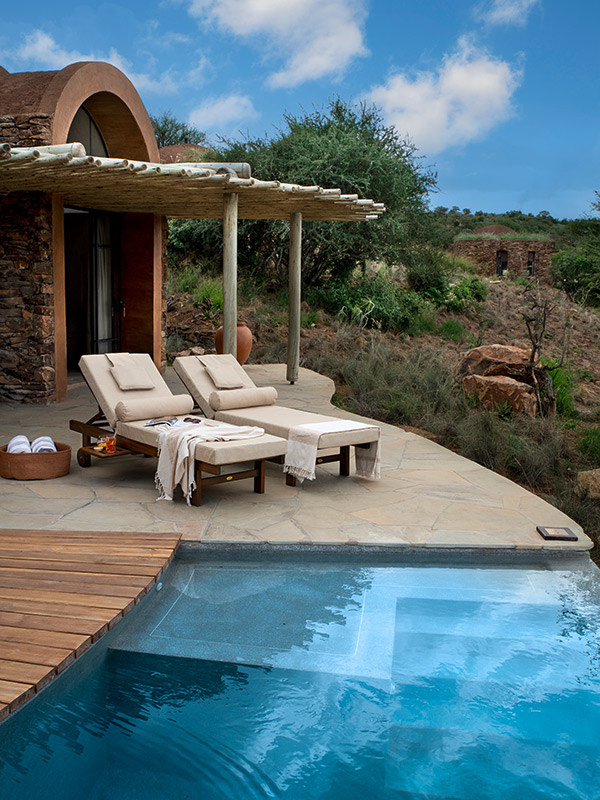
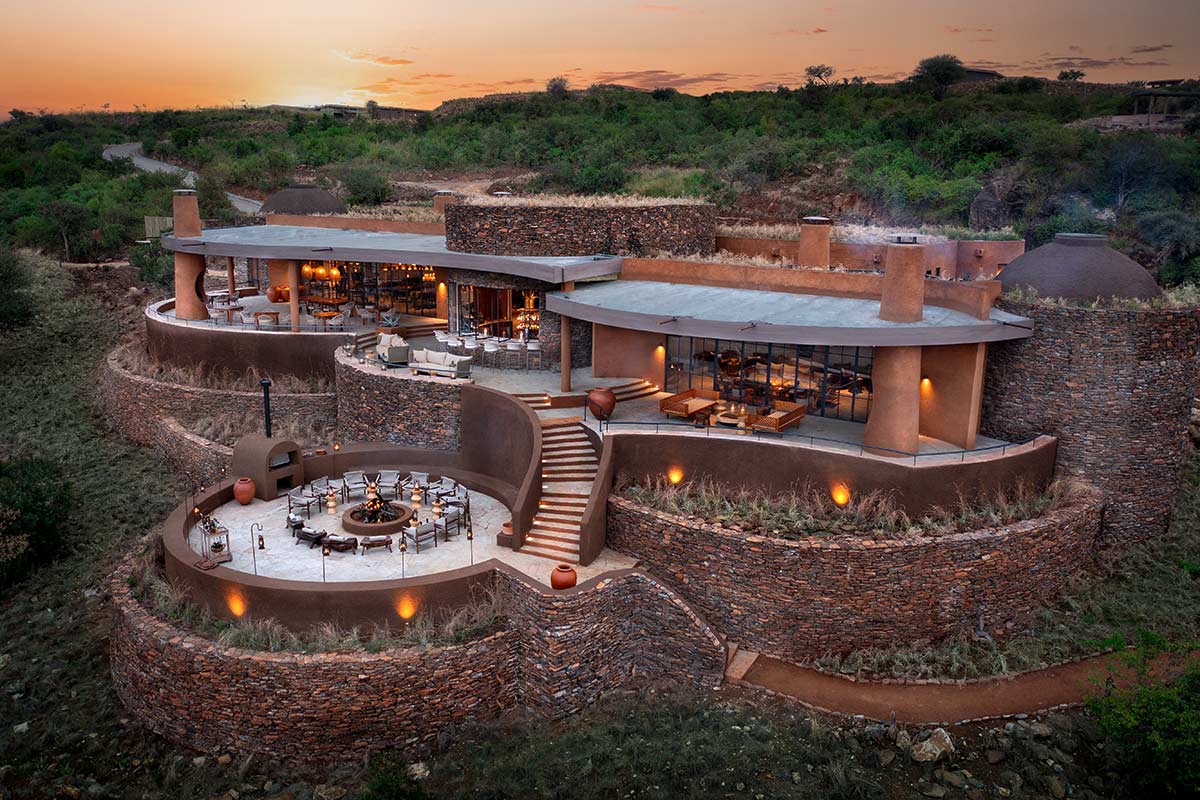
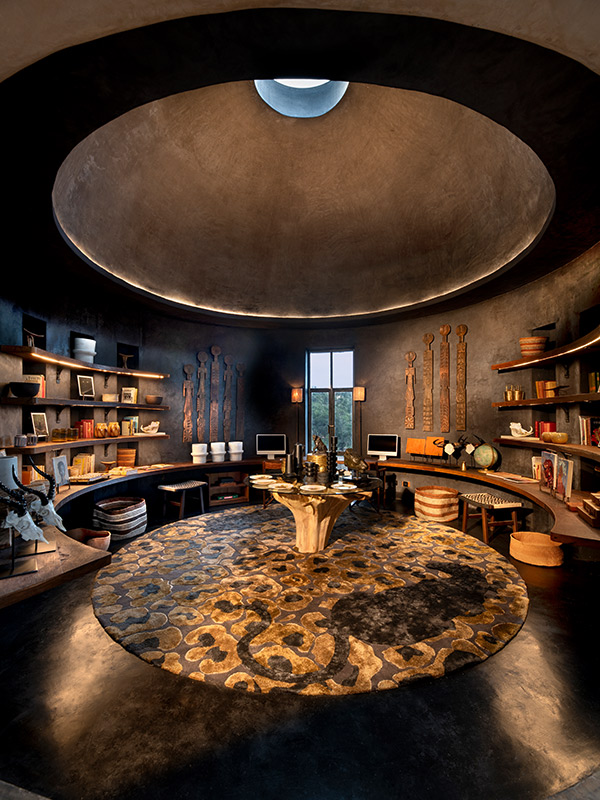
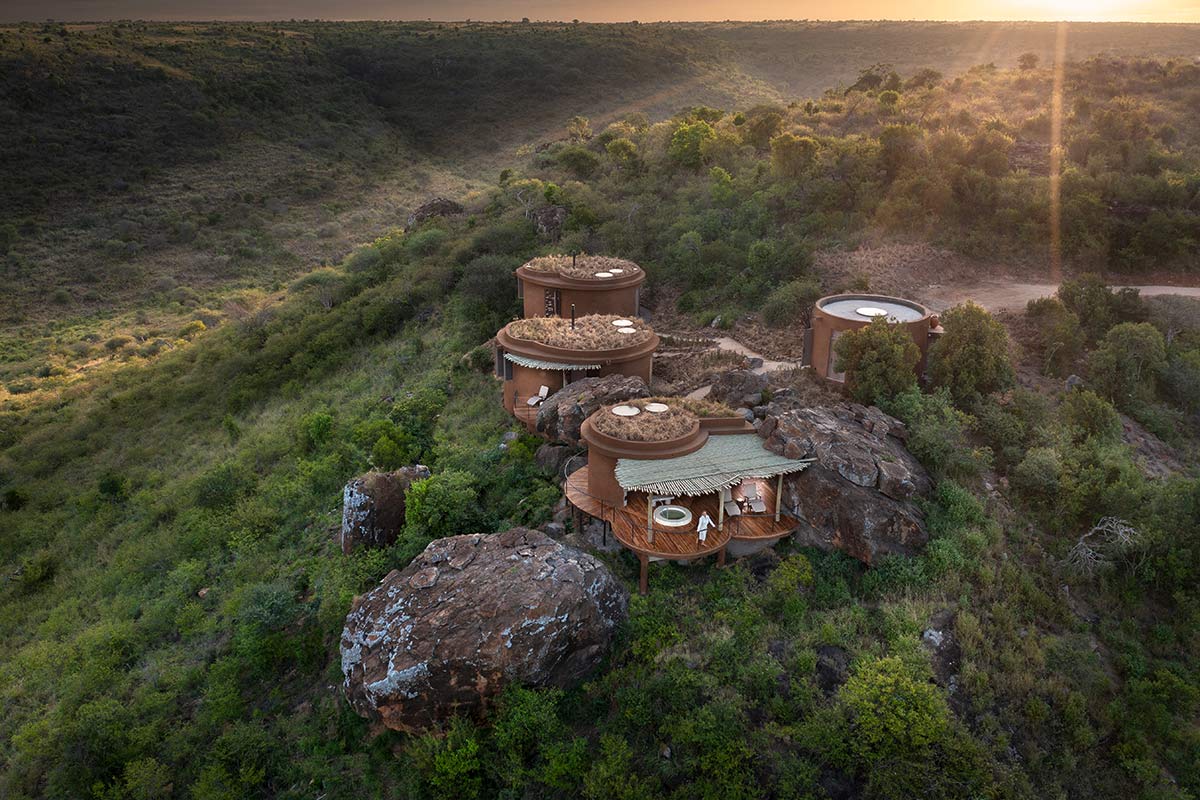
Don’t worry, he won’t bite. The statue of an African wild dog stalks through the bushes at the entrance to Suyian Lodge. At first glance, the main building and the 14 freestanding suites look like just a few more brown-gray kopjes—small, spherical granite hills that characterize the savanna landscape. Built of natural stone and partially overgrown with plants, the buildings do not stand out from nature as foreign objects but are part of it. Even after entering the hotel, guests feel as if they are in a cozy cocoon of clay, leather, and wool. Architecture and design studios from South Africa and England drew inspiration from Afro Wabi-Sabi for the design: the Japanese design philosophy of imperfection, interpreted through Afrocentric aesthetics and regional materials. Like a rock python slithering forward, the rooms and interiors feature artfully curved forms. Subtle in color, their power is revealed only through touch: rough walls, soft carpets, crackling woven fabrics. The elements of the savanna have been gently tamed for the Habitat. But only to the extent that they offer guests style and comfort without losing their natural character. Flames crackle. In the lanterns scattered throughout the entire complex. And in the large fire pit that welcomes visitors in the entryway of each suite. Fire plays a central role in the traditions of the Samburu and Maasai, which are still practiced today. It protects people and animals, initiates rituals, and illuminates the faces of the elders as they pass down legends and wisdom. At Suyian Lodge, the ever-present fire is an invitation to quiet reflection. Whether during a candlelit dinner by the pool or while gazing from the terrace at the greatest of all fires—the sunset—if one truly wishes to find peace, one must sometimes venture deep into the wilderness.
&BEYOND SUYIAN LODGE
A few years ago, the African wild dog seemed to be, well, going to the dogs. But now the species is regaining its former strength and has even lent its name to the Suyian Lodge in Kenya. The lodge’s 14 guest suites, along with its main and auxiliary buildings, blend harmoniously into the majestic landscape of the dry savanna. At the heart of the Suyian Conservancy, the pulse of virtually untouched nature beats. Various expeditions offer the opportunity to explore it. But between us: A glance out the panoramic window from the king-size bed is enough to be overwhelmed by the landscape. andbeyond.com
Teaser: For everyone who’s all fired up about nature vacations.
Are you afraid of wild animals? We have more travel tips in store.
Off into the wilderness.
Photos: © Beyond Suyian Lodge