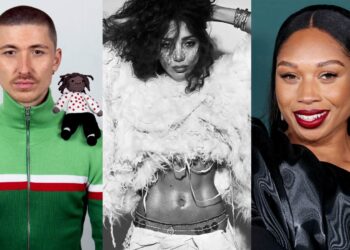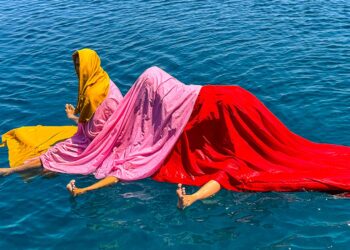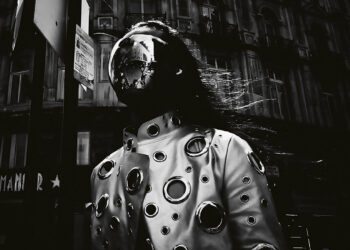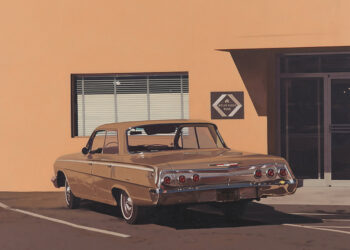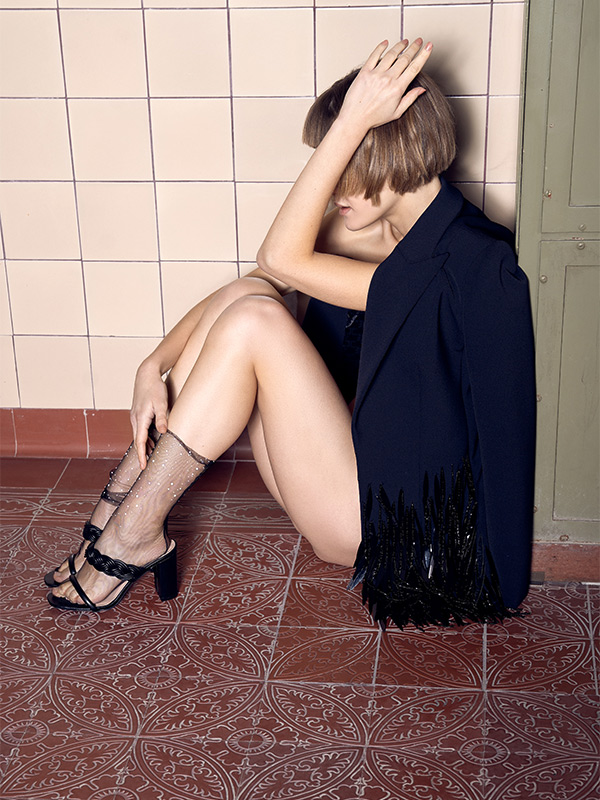

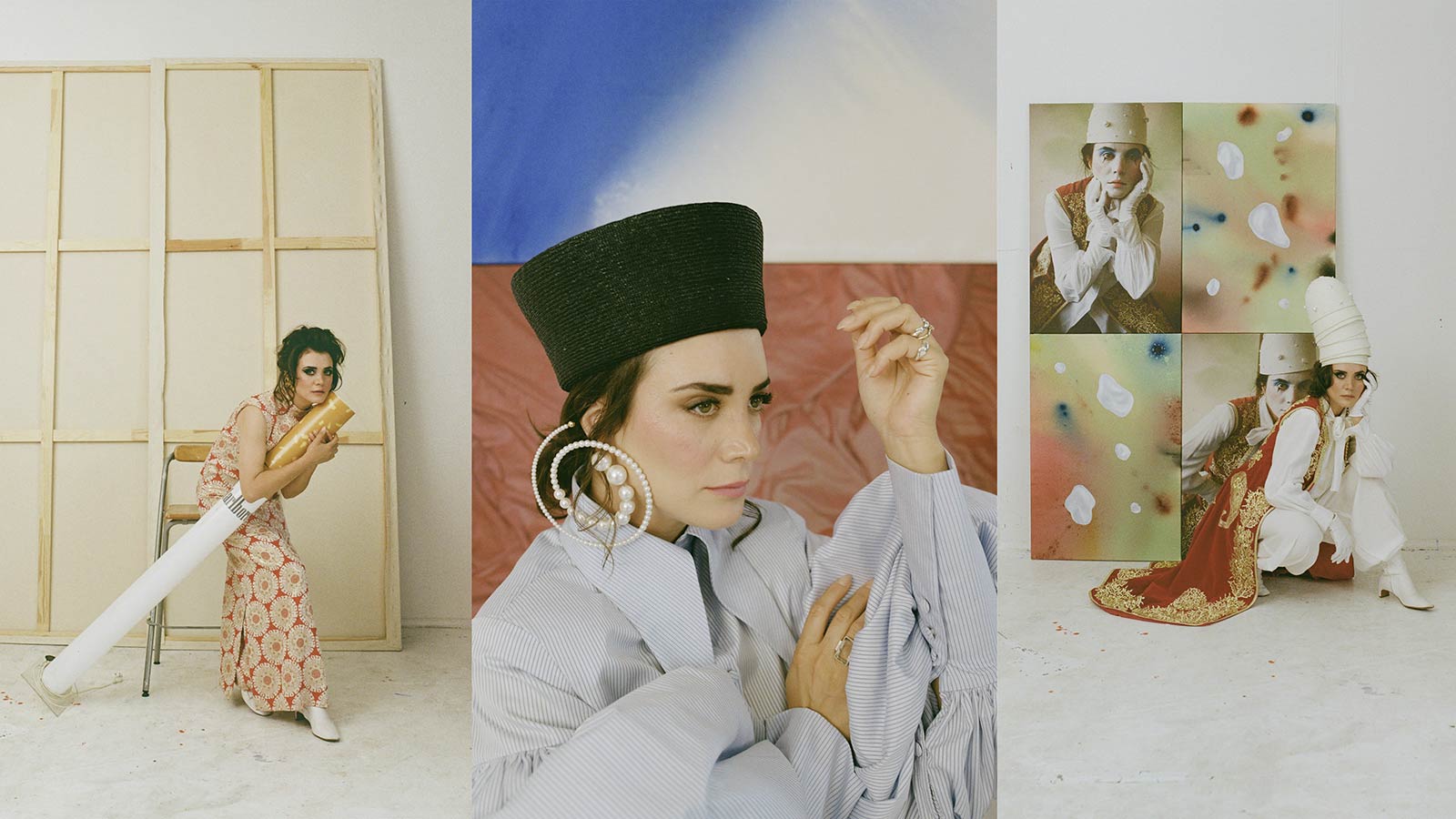
Photography: Viola Patzig @violapatzig
Styling: Florian Winges @_f_l_o_w_w_w_
Make-up & Hair: Angelique Waltenberg @angelique.waltenberg
Talent: Dënalisa Shijaku @denalisa.shijaku
Paint, brushes, large canvases: that’s what it takes to make artist Dënalisa Shijaku happy. In her painting, she processes emotions and makes the unspeakable visible. She also works as a nurse. In this interview, the Berliner-by-choice reveals what she learns from these two different professions, how she incorporates her Albanian roots into her art and what people without a migration background urgently need to learn.
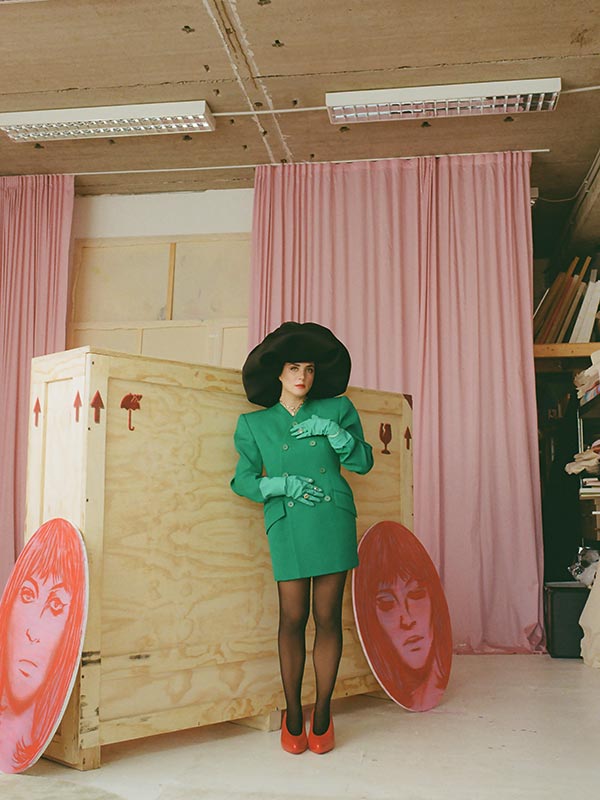
FACES: “What is boiling inside me demands to be expressed,” you say on your website. What is bubbling up inside you most strongly right now and how do you express it?
Dënalisa Shijaku: I have some exciting projects coming up at the moment and I feel a strong desire to delve deeper into the world of oil painting. But I’m also interested in sculpture, performance art and installation art. I want to understand the techniques, apply them and open new doors within my art.
Q: And your Insta bio says “All staging, all real”. Where is the line between staging and reality? What are you staging?
DS: What is real and what is staged? I think the two are intertwined. Even getting up, getting dressed, showing off is all a form of staging. But that’s where the truth lies. We don’t stage ourselves to be fake, but to find ourselves and to make visible what’s inside us. Perhaps what we call “real” is simply the most honest form of staging.
Q: How would you describe yourself to someone who has never heard of you?
DS: I am a seeker. One who feels, thinks and paints. Sometimes at the same time, sometimes mixed up.
Q: When did you take your first artistic steps and how much has your art changed since then?
DS: I’ve always painted – I just didn’t know it was art before. It wasn’t until I started sharing my paintings on social media and people responded to them that I understood that what I do actually does something to others. A lot has changed since then: I’ve become braver, more honest, perhaps more experimental. But the core has remained the same. This need to make what is inside me visible.
Q: Do you remember a moment when you thought to yourself: I want to be an artist?
DS: I don’t remember the exact moment. But apparently others knew long before I realized it myself. Sometimes old acquaintances write to me on Instagram and say that even back then – as a teenager – I always talked about being an artist one day. These messages really touch me. It’s nice to see that something that was once just a sentence has now become my life.
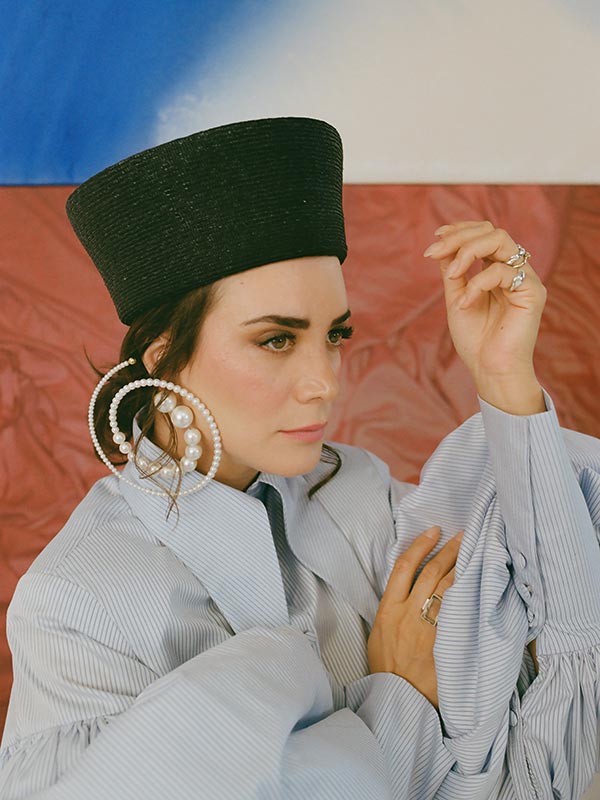
“My art grows with me.”
Q: When it comes to creativity – how much is talent, how much is hard work and practice?
DS: Talent is the beginning, but without diligence and dedication it remains silent. Creativity takes time, patience and the willingness to start again and again. At the same time, I don’t think of art in terms of performance or discipline in the classic sense. Marina Abramović once said that you don’t think about breathing – you just do it. It’s the same with art: I don’t do it because I want to, but because I can’t help it.
Q: Have you ever completely painted over a painting because it just didn’t turn out the way you wanted it to? If so, how did it feel?
DS: It happens more often than you think. Most of the time it feels liberating and every now and then you regret it. But there’s no going back.
Q: What can a painting express that words cannot?
DS: A painting or art in itself can make the inexpressible visible. Experiences such as sadness, ecstasy, longing that are difficult to put into words. A painting can make such emotions visible without having to name them. And that is the beauty of it. Paul Klee said: “Art does not reproduce the visible, but makes visible.”
Q: Where do you find your inspiration?
DS: Music, books and melancholy are definitely my biggest sources of inspiration. I feel the most when I’m suffering. And that in turn means: I see colors. It’s not about physical pain. A song that reminds me of the past is often enough. Even if I may never have experienced the past. This gentle nostalgia, the feeling of “back then”, turns into energy. I love that.
Q: Which work by another artist would you most like to have made yourself?
DS: I would have liked to paint “The Ten Greatest” by Hilma af Klint. They feel like they come from another dimension. Just thinking about these works gives me goose bumps.
Q: If you had to describe your art in terms of other art – which works would most closely correspond to your own?
DS: If my art were music, I would describe it as that of the band Cigarettes After Sex. The dreamy, melancholic, atmospheric sound is exactly what I personally see in my art.
Q: What worries you the most at the moment and how does art help you to deal with it?
DS: Life itself is my biggest worry. The speed, the instability. I see everything moving and feel how difficult it is to keep up, to do justice to everything and everyone. I find a counterbalance in art. It forces me to look, to feel, to slow down. There is comfort in that.
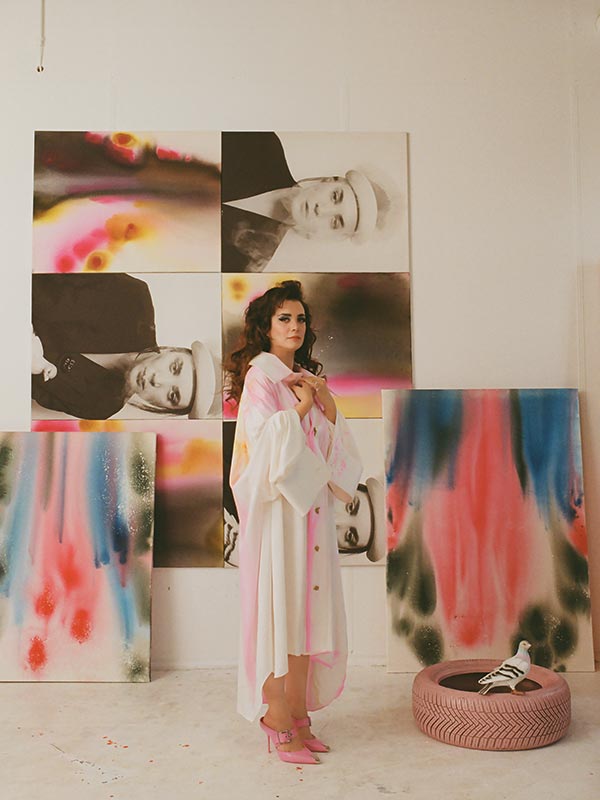
“Perhaps what we call ‘real’ is simply the most honest form of staging.”
Q: Are there any colors that you find completely awful or do you think you can create something beautiful with all colors?
DS: I can’t do much with the color gray. I like to leave it to other artists to create something beautiful with this color.
Q: What does fashion mean to you and how do you incorporate it into your creative work?
DS: For me, fashion is a form of expression, almost like painting, except that the canvas is the body. I don’t see it as a trend or status symbol, but as a way of making moods visible. It says something about identity, about change, about what you want to show or hide.
Q: If you had to describe your art style as a fashion label(s), what would it be?
DS: My art style would be a mixture of Robert Wun, Dries Van Noten and Balenciaga. From Robert Wun comes the futuristic, emotional, almost sculptural. His designs are like works of art, strong and vulnerable at the same time. Dries Van Noten stands for color, melancholy and depth. The poetic, which also lives in my pictures. And Balenciaga brings in the raw, the non-conformist, sometimes even the uncomfortable. This mixture of elegance, emotion and edge probably describes the field of tension in which my art moves pretty accurately.
Q: Do you have a favorite image or do you think you’re yet to create your favorite image?
DS: Many artists I admire have created great works at an advanced age. And of course I also want to continue to develop and improve. So my favorite painting is always my next one.
Q: In which direction would you like your art to develop?
DS: My art grows with me. It is not a destination, but a path. The older I get, the clearer I see what really remains. It is my anchor and should remain so. That’s all I ask of it.
Q: Who would you most like to collaborate with?
DS: I would love to work with a fashion label or perfume house – to create something that you can not only see, but also feel. Working on a huge installation, or clothing and artwork at the same time. Painting huge canvases and using them as a stage set for a perfume advertisement. From Gucci and Balenciaga to Dries Van Noten, there are several brands that interest me.
Q: You also work as a nurse alongside your art. At first glance, that’s an unusual combination. How do the two professional fields complement each other and what do you draw from one that might help you in the other – and vice versa?
DS: In nursing I learn to see life, in art I learn to feel it. The two belong together.
Q: Do you sometimes find it difficult to combine the two activities? Do you have any free time at all?
DS: In addition to my mini-job as a nurse, I also work as co-curator and creative director at LABA Berlin. Some weeks are tightly scheduled, but art always finds its way. It doesn’t have working hours, it’s just there, in every break, in every thought, in everything I do.
Q: What needs to change most urgently in healthcare? And what in the art world?
DS: In the healthcare sector, I see a system that has become tired. Fair pay and enough specialists would improve things a lot. But that’s so easy to say. In the art world, there needs to be less pressure to always be visible and more space for the feeling itself.
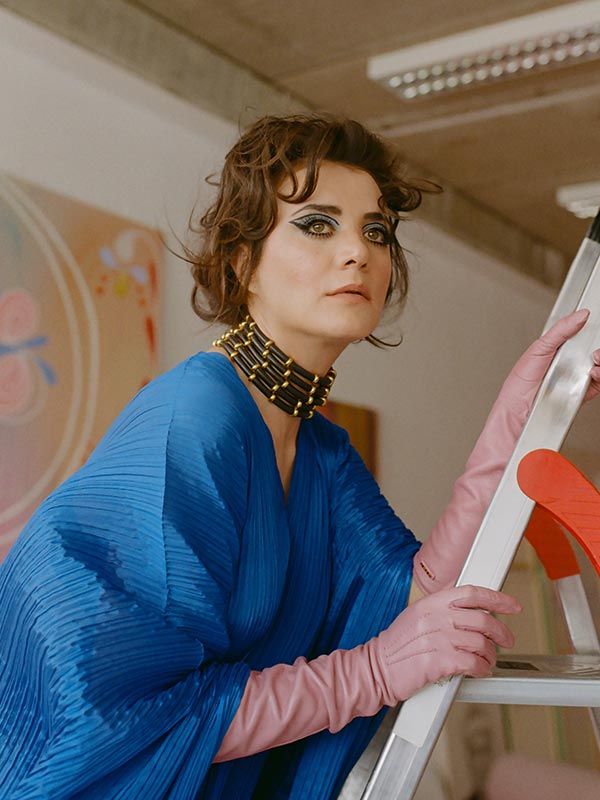
“I don’t see my art as a political duty, but as an opportunity.”
Q: To what extent are you / your body itself part of your art?
DS: Making yourself a motif is not an end in itself. It is a tool, perhaps even the most honest one we have, to express something deeper: inner states, transformation, identity, strength, vulnerability. If my hands manage to fill a blank canvas, then they deserve to be depicted themselves from time to time. That is only fair.
Q: You also deal with themes of origin. If you could only broadcast one message about this to the world, what would it be?
DS: “Never forget where you come from, even if you may never fully know it in the end.” I was born in Kosovo but grew up in Germany. Being caught between these worlds means having two identities and yet never fully arriving anywhere. Perhaps it is precisely this “in-between” that has become my home and my art the place where the two meet.
Q: To what extent do you feel obliged to convey a certain message as a woman with Albanian roots – especially now that society is becoming more openly xenophobic again?
DS: I don’t see my art as a political duty, but as an opportunity. As a woman with Albanian roots, I am part of a story that is often misunderstood or overlooked. By remaining visible, by taking up space and expressing myself, I am already sending a message, even without saying it. If someone recognizes something about origin, strength or identity in this, I am happy. But I don’t want to speak for an entire community – I just want to be honestly myself.
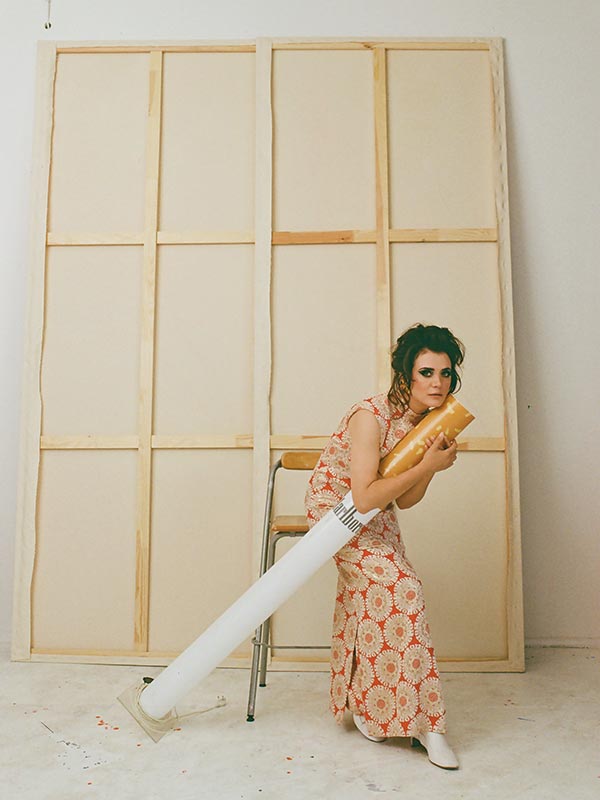
Q: What do people without a migration background most urgently need to learn and do differently in order to ensure peaceful and open coexistence? Who do they need to listen to?
DS: People without a migration background should learn to really listen – not to answer, but to understand. It’s not about apportioning blame, but about opening up spaces: for stories, for differences, for new perspectives. Most urgently, they should listen to those who are rarely asked. Those who live between cultures and still try to belong every day.
Q: How do you define “home” and where do you feel most at home?
DS: For me, home is not a place, but a state. Sometimes I find it in people, sometimes in music, films or colors. I feel at home where I am allowed to be myself. Wherever that may be.
Q: How would you describe Berlin? Which clichés are true? Does the city help you to live out your art?
DS: Berlin is loud, honest and sometimes simply too much. Many clichés are true: The city is raw, unpolished, chaotic. But that’s exactly what I like about it. I constantly meet new, exciting people in Berlin and this leads to conversations, connections and opportunities. I’m invited to exhibitions and events and my network is growing. At the same time, I have a large, affordable studio here. I wouldn’t be able to get either anywhere else – at least not in the cities I’m interested in.
Q: If you didn’t live in Berlin for a year, where would you go and how would your art change?
DS: Definitely New York City. This city does something to me. Every time I’m there, I feel a nostalgia that immediately takes hold of me. It’s probably because of all the movies I watched as a child. My art would probably be more expensive there. How else would I be able to afford to live there as an artist? (laughs)
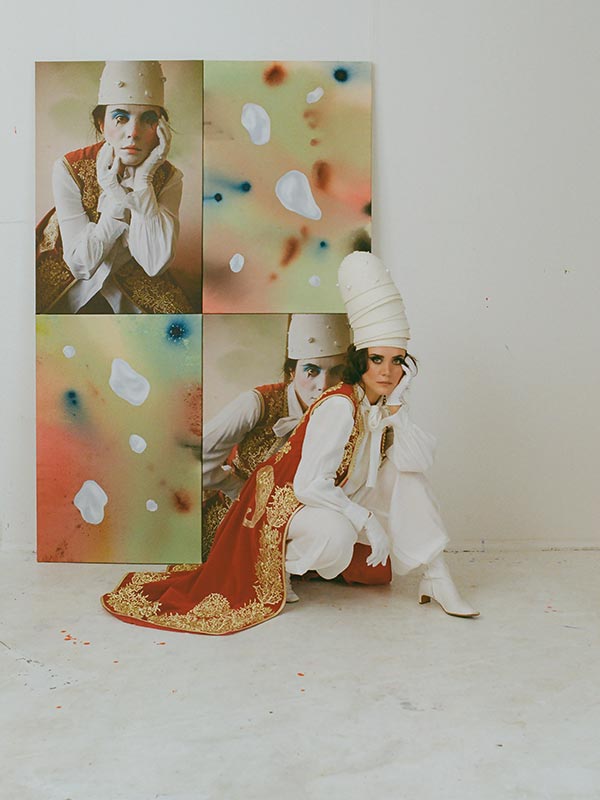
“Creativity takes time, patience and the willingness to start again and again.”
Q: How does social media influence your work?
DS: Social media can be both a curse and a blessing. It creates visibility, but also pressure. I had to let go of wanting to please. But of course it’s difficult to completely distance yourself from it when you also earn your money via social media. You can’t switch off completely either. It’s a balancing act between authenticity and algorithms. Just like in my bio: it’s all staging. It’s all real. (laughs)
Q: What would you like to say to a younger version of yourself right now?
DS: You are neither too much nor too little. You are just right, just at the wrong time.
Q: Are you more introverted or extroverted? Which colors best describe your disposition?
DS: I’m a mixture of both. I’m very open around people I know. In new situations, I tend to be quiet and observant. My colors would be a deep blue and a warm red: calm and fire at the same time.
Q: What do you think about AI, specifically people using AI to make art?
DS: I honestly don’t care what tools people use to make art – that’s their choice. For me, AI is just another tool. I don’t worry about it because my tool is still painting. Only time will tell whether it will remain so forever.
Q: Who would you love to see one of your paintings in their living room?
DS: With Bob Dylan.
Q: What’s on your bucket list – professionally and/or privately?
DS: There really is a lot on it – the list is endless. But definitely on it: another solo exhibition of my new series and, of course, an artist residency in New York.
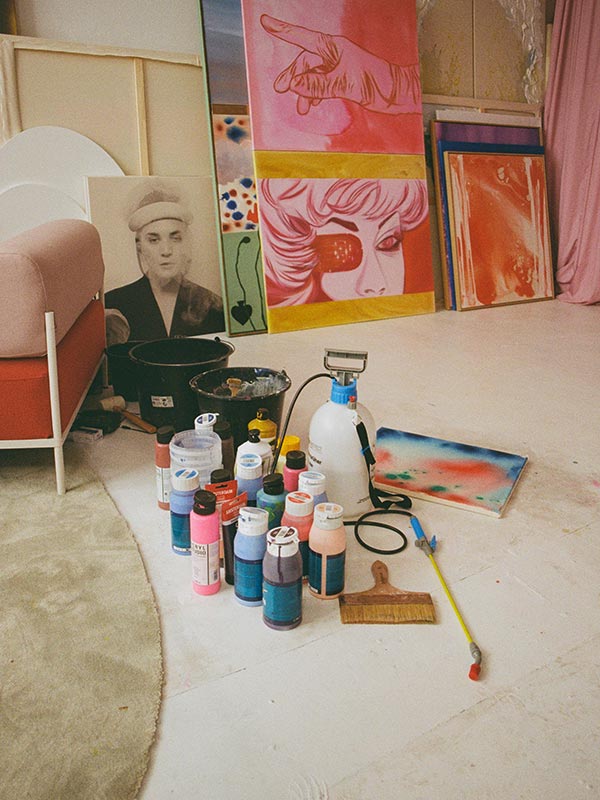
Dënalisa Shijaku
When Dënalisa Shijaku gets her hands on brushes, acrylic and oil paints and canvases, great emotions arise in her Berlin studio. She has been painting since childhood and transforms melancholy emotions into surreal and colorful works of art. She is never short of inspiration: In addition to art, Dënalisa works as a nurse, co-curator and creative director.
Stay up-to-date with Dënalisa @denalisa.shijaku
Photos: © Viola Patzig
Also from Berlin and at home in the art world: read our interview with gallery owner Anahita Sadighi here.